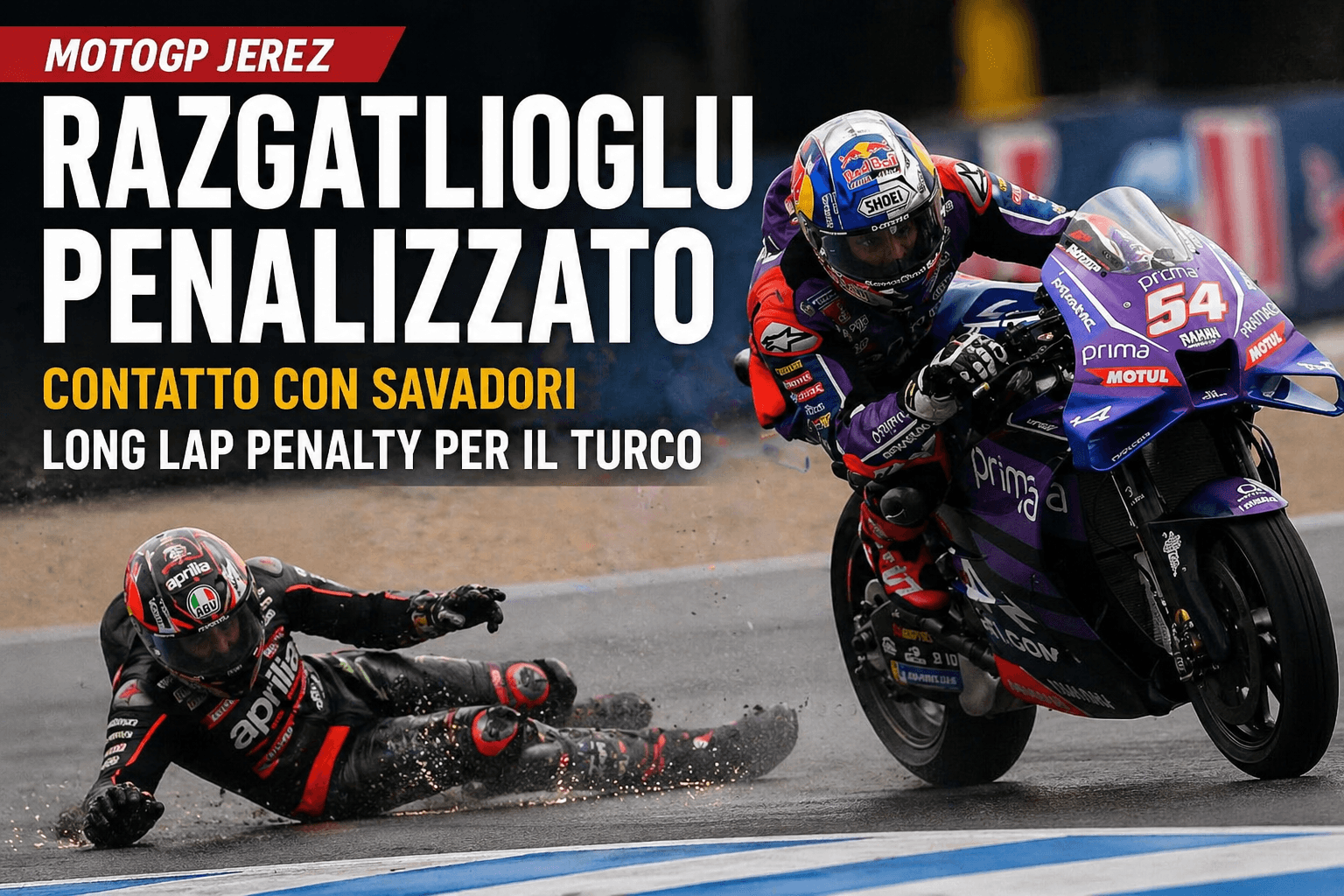
The Sprint Race of the Spanish Grand Prix at Jerez delivered a spectacle that was as unpredictable as it was controversial. Between rain, crashes and risky strategies, the focus was on the contact between Toprak Razgatlioglu and Lorenzo Savadori, an incident that led to the Turkish rider being penalised with a Long Lap Penalty to be served in Sunday’s main race.
An incident that not only affected the race of the two protagonists, but also rekindled the debate over the line between aggression and recklessness in MotoGP.
The incident: a mistake in the attack phase
The contact occurred during an already chaotic phase of the Sprint, when the group was tightly packed and every position was defended firmly. Razgatlioglu, in an attempt to get past Franco Morbidelli and make up ground, forced his way into the corner with a move on the limit.
A loss of front-end grip made the impact with Savadori inevitable, as he was on the ideal line. The Italian rider, caught up in it with no chance to respond, went down and ended his race, while the Turkish rider also lost time and rhythm.
A quick incident, but enough to be assessed carefully by Race Direction.
The decision: Long Lap Penalty for Razgatlioglu
The stewards had no doubts about attributing responsibility for the incident to Razgatlioglu. The move was judged overly optimistic and not compatible with the track conditions and the traffic at that moment.
The sanction imposed is a Long Lap Penalty, now the standard measure for this type of offence. The Turkish rider will therefore have to use the widened lane during Sunday’s race, losing precious seconds at a crucial stage.
A penalty that weighs heavily, especially in a championship where every detail can make the difference.
The reactions: between regret and analysis
At the end of the race, Razgatlioglu acknowledged the mistake, stressing how the difficult conditions had made it hard to stay within the limit. The Turkish rider explained that he had tried to take an opportunity, but had lost control on corner entry, implicitly admitting responsibility for the contact.
On the other hand, Savadori expressed frustration at an incident that deprived him of the chance to finish a race in which he was trying to collect important data for Aprilia. The Italian rider highlighted how situations like this are particularly punishing for those with no margin for error.
A Sprint out of control: the race context
The incident came in a Sprint already marked by chaos. Rain suddenly changed the track conditions, forcing the riders into quick and often risky decisions. High-profile crashes and bike changes turned the standings upside down.
Marc Marquez was able to take advantage of the moment, turning an early crash into a sensational victory thanks to a perfect call in switching to the wet bike. Behind him, Francesco Bagnaia built a highly solid second place, while Franco Morbidelli completed the podium with a surprising comeback.
Morbidelli himself was one of the riders indirectly involved in the incident, finding himself in the middle of the battle that led to the contact between Razgatlioglu and Savadori.
Technical analysis: the line between spectacle and risk
The Jerez incident highlights a central issue in modern MotoGP: the boundary between aggression and error. Razgatlioglu is a rider known for a spectacular style, built on deep braking and decisive moves on the inside.
However, the MotoGP context requires absolute precision. Aerodynamics, tyre management and the density of the group drastically reduce the margin for manoeuvre. In these conditions, even an apparently normal move can turn into a decisive mistake.
The contact with Savadori represents exactly this: a legitimate attempt, but executed without the necessary margin.
A lesson for the rest of the season
The Jerez Sprint leaves behind a spectacular race but also an important reflection. Razgatlioglu will have to serve the penalty and, above all, adapt his style to the demands of MotoGP.
Speed is not in question, but the difference between a great result and a negative episode comes down to the ability to read the context and choose the right moment to attack.
Jerez, in this sense, provides a clear lesson: talent must always be matched by restraint.