The Catalan GP becomes a global case: “You can’t race like this”
It was meant to be one of the most spectacular events of the season, but instead it turned into an afternoon of fear, controversy and very serious accusations. The 2026 Catalan Grand Prix left the MotoGP paddock in a state of tension rarely seen in recent years, amid violent incidents, two red flags and race management that fuelled the riders’ discontent.
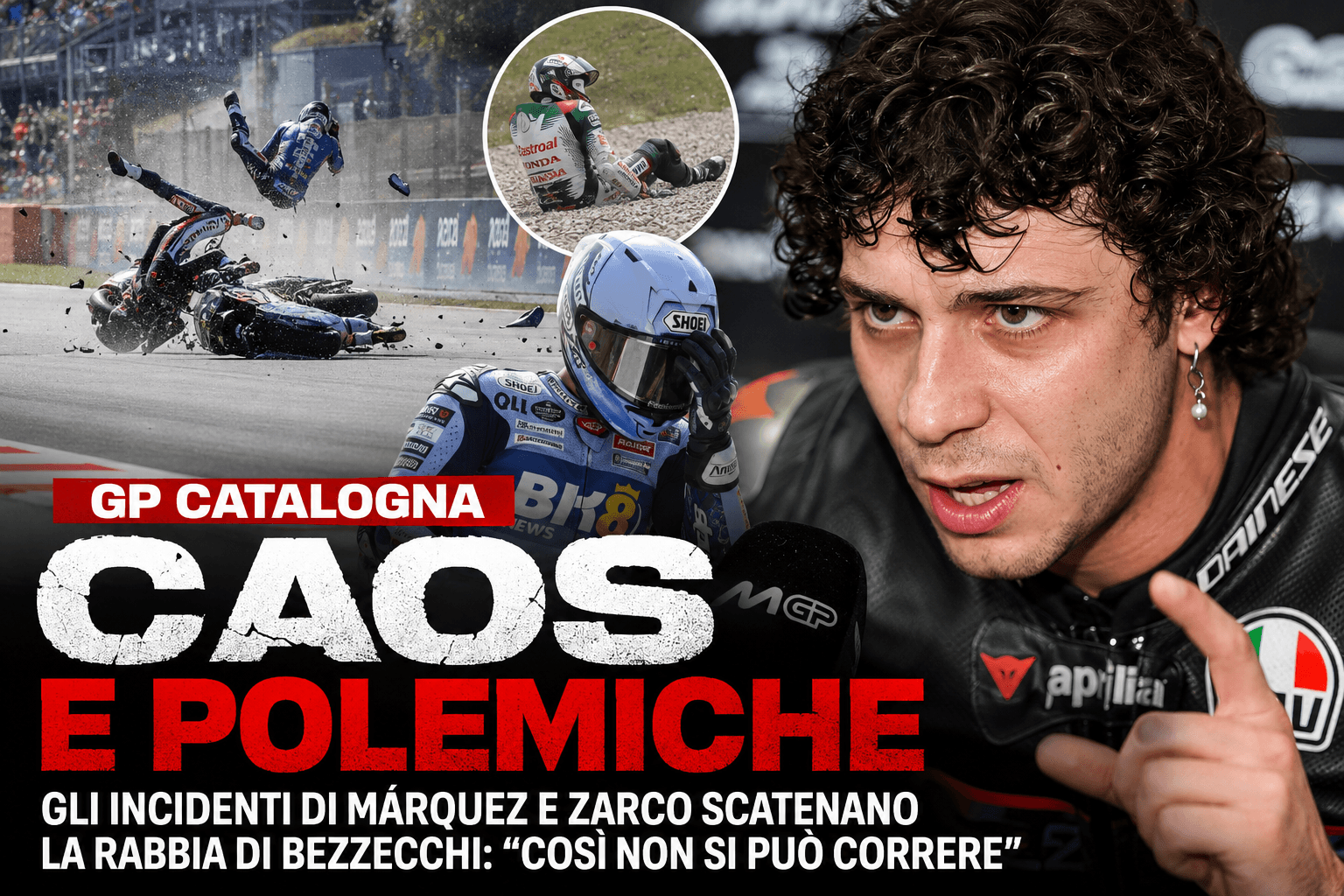
What shook the World Championship above all were the dramatic crashes of Álex Márquez and Johann Zarco, both taken to hospital after high-speed impacts. Incidents that sparked a fierce reaction from Marco Bezzecchi, one of the riders most critical of race direction and the entire safety system.
The Romagnol rider on the Aprilia, visibly shaken after the race, did not hide his anger: in his view MotoGP is crossing a too dangerous line in the name of spectacle.
Álex Márquez's incident freezes Montmeló
High-speed contact and a destroyed bike: dramatic moments on the straight
The first shocking moment comes in the middle phase of the race. Pedro Acosta, fighting for victory, suddenly slows on the main straight because of a technical problem. Behind him Álex Márquez finds himself with no space and no time to avoid the impact.
The collision is devastating. The Spaniard's Ducati breaks apart against the barriers while pieces of the bike invade the track, narrowly missing the riders coming up behind. Fabio Di Giannantonio loses control in an attempt to avoid the debris and goes down a few metres later.
For several seconds the Montmeló circuit falls silent. Marshals intervene immediately while race direction shows the red flag. Márquez is assisted on track and taken to hospital for urgent checks.
The first diagnoses point to a fractured collarbone and cervical trauma, but without neurological complications. News that at least partly eases the tension felt in the paddock.
Second restart and fresh chaos: Zarco flies into the gravel
Bagnaia and Marini involved in a massive pile-up at the first corner
The situation, however, quickly collapses again after the restart. With cold tyres and the group packed together, the atmosphere on track remains extremely nervous. On braking for the first corner Johann Zarco suddenly loses the front and ends up in the middle of the pack.
His Honda slides violently, also involving Francesco Bagnaia and Luca Marini in an incident that once again forces race direction to stop everything. Zarco remains on the ground in pain while the medical team quickly enters the track.
The Frenchman is taken to the medical centre with a suspected knee ligament injury and a fracture in his right leg. Bagnaia and Marini, although in pain, are instead able to return to the pits without serious consequences.
The images of the second incident immediately go around the world and reopen the debate on MotoGP's modern safety standards.
Bezzecchi attacks: “We have gone beyond the limit”
The Aprilia rider shakes the paddock after the Catalan GP
Among the strongest voices to emerge after the race is Marco Bezzecchi. The Italian rider does not mince his words and describes a situation out of control, saying he saw pieces of the bike flying on track at astonishing speed.
According to Bezzecchi, the problem is not only the incidents themselves, but the way increasingly extreme situations are managed. The Aprilia rider suggests that the pressure to keep the TV spectacle alive sometimes risks taking priority over protecting the riders.
His statements also find agreement among other paddock figures. Pecco Bagnaia openly speaks of a race “too dangerous”, while Fabio Di Giannantonio underlines how in recent years MotoGP has reached speed levels that are difficult to control in certain conditions.
MotoGP safety: the Barcelona case could change the championship
Riders and teams ask for urgent talks with FIM and race direction
What happened at Montmeló now risks having major consequences for the category's future. Several riders are calling for an immediate review of the protocols linked to red flags, restart procedures and the management of high-risk situations.
The spotlight also falls on some characteristics of the Catalan circuit, long considered one of the most critical tracks on the calendar because of the reduced run-off areas in the fastest sections.
The safety issue thus returns to the centre of MotoGP just as the bikes continue to become more powerful, faster and ever closer together in the early stages of the race.
The shared fear in the paddock is that episodes like those seen in Barcelona could happen again.
Di Giannantonio takes the GP, but the paddock thinks about the incidents
In the end Fabio Di Giannantonio wins the Catalan Grand Prix, doing well to stay composed in the general chaos and to make the most of a completely unpredictable race. Also on the podium are Fermín Aldeguer and Francesco Bagnaia, while Marco Bezzecchi finishes just outside the top three, keeping valuable points in the World Championship chase.
And yet the sporting result is almost secondary. In the paddock, on social media and among insiders, people continue to talk above all about the dramatic images seen at Montmeló.
MotoGP leaves Barcelona with many unanswered questions and an increasingly obvious certainty: the line between spectacle and safety has never been so fine.