Qualifying for the Catalan GP reignites the debate on safety
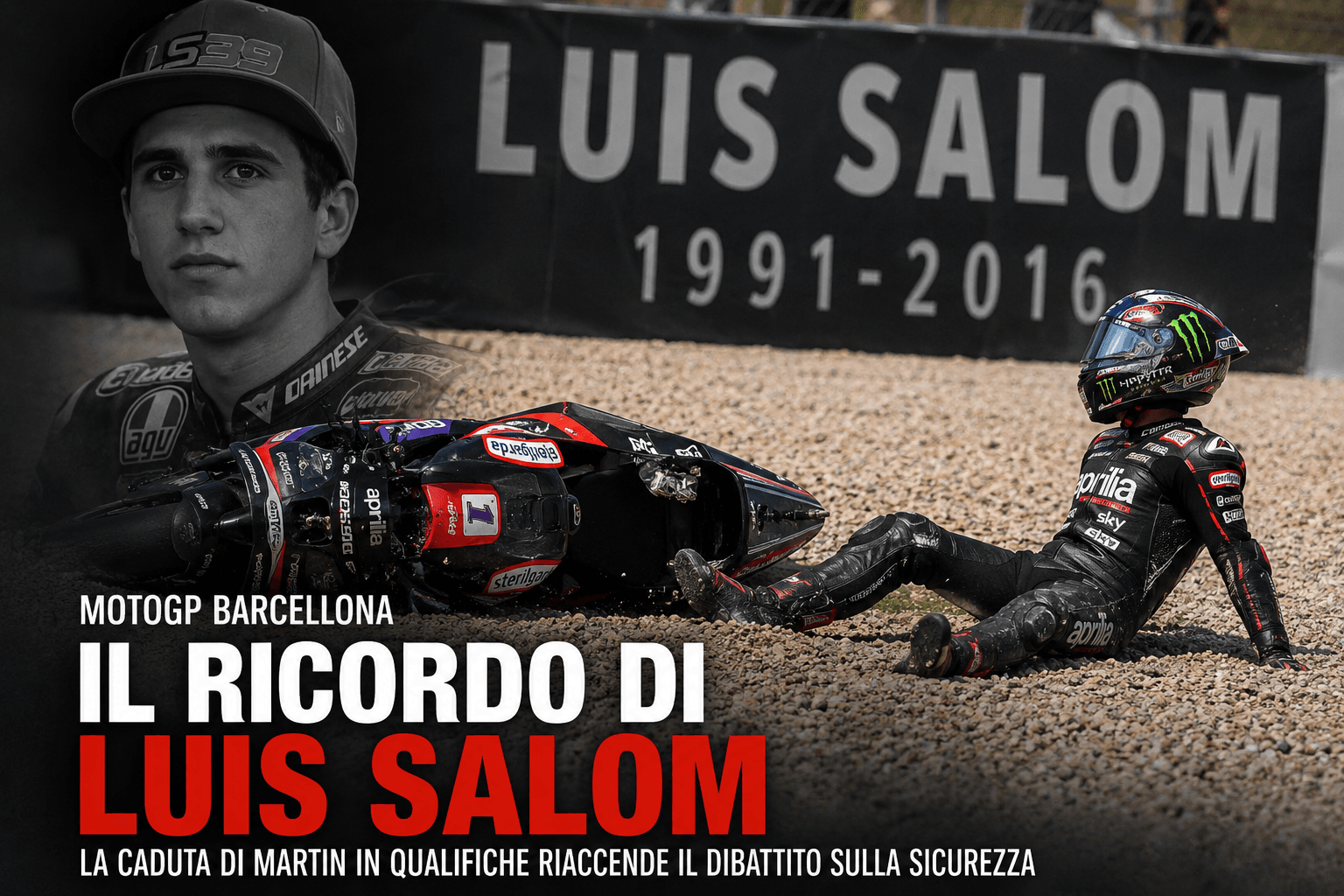
Barcelona is back at the centre of the discussion on safety in MotoGP. Jorge Martin's violent crash during qualifying for the Catalan GP has brought the paddock back to a wound that was never truly healed: the one linked to Luis Salom's death in 2016.
The Aprilia rider's crash at Turn 12 brought back, for a few moments, images and sensations that motorcycle racing has never forgotten. Martin lost control of the bike at high speed, ending up in the run-off area after a particularly dangerous sequence. Once back in the pits, the world champion uttered words destined to leave their mark in the paddock.
“When I crashed, I immediately thought of Luis Salom”. A direct, powerful phrase that immediately took the Montmeló circuit back in time.
Jorge Martin and the fear felt at Turn 12
The Spanish rider did not hide the fear he felt during the incident. Martin explained how that section of the circuit remains extremely delicate despite the changes made in recent years, stressing the need to keep working on safety.
His statements had a strong impact among riders and insiders, above all because of the immediate reference to Luis Salom. Turn 12 of the Catalan track is in fact one of the most symbolic and painful points in the recent history of the World Championship.
According to Martin, modern MotoGP bikes have reached performance levels that require constant reflection on the evolution of historic circuits. Higher speeds, ever more aggressive braking and exaggerated aerodynamics are profoundly changing the dynamics of crashes.
Luis Salom, the tragedy that changed Montmeló
The name of Luis Salom remains indissolubly linked to the Catalan GP. The Mallorcan rider lost his life on 3 June 2016 during Moto2 free practice on the Barcelona track, in an incident that shocked the world of motorcycle racing.
After that tragedy, the circuit was modified during the same weekend with the introduction of the variant used by Formula 1 to slow down the sector in question. In the years that followed, further work was carried out on the run-off areas and the barriers, but the safety issue continues to remain central.
Every time there is a major crash at Montmeló, the memory of Salom inevitably resurfaces. And that is exactly what happened during qualifying for the Catalan GP, with the paddock suddenly brought back before the fragility of this sport.
Bagnaia and the appeal to the riders: “More participation is needed”
During the Catalan weekend, Pecco Bagnaia also spoke on the safety issue, highlighting the importance of Safety Commission meetings. The Ducati rider stressed how often not all the protagonists of the World Championship actively take part in discussions about circuits and track conditions.
A clear message, delivered in a weekend where the crashes once again sparked the debate between riders, Dorna and the Federation. The shared goal remains to continuously improve safety standards without distorting the DNA of MotoGP.
Modern MotoGP remains an extreme sport
The Barcelona weekend once again reminded everyone how motorcycle racing remains one of the most dangerous sports in the world. Despite the enormous progress made by technology, risk continues to be an integral part of MotoGP.
Airbag suits, modern protections and the continuous updates to circuits have significantly reduced the consequences of the most serious crashes. But when you crash at over 200 kilometres per hour, every detail can become decisive.
And it is precisely this awareness that makes the memory of Luis Salom still so present in the paddock. Not only as the memory of a rider gone too soon, but as a symbol of the harshest reality of motorcycle racing.
Because behind the spectacle of the races, the late-braking manoeuvres and the wheel-to-wheel battles, there is always a very thin line between adrenaline and tragedy. And in Barcelona, that line continues to be impossible to forget.