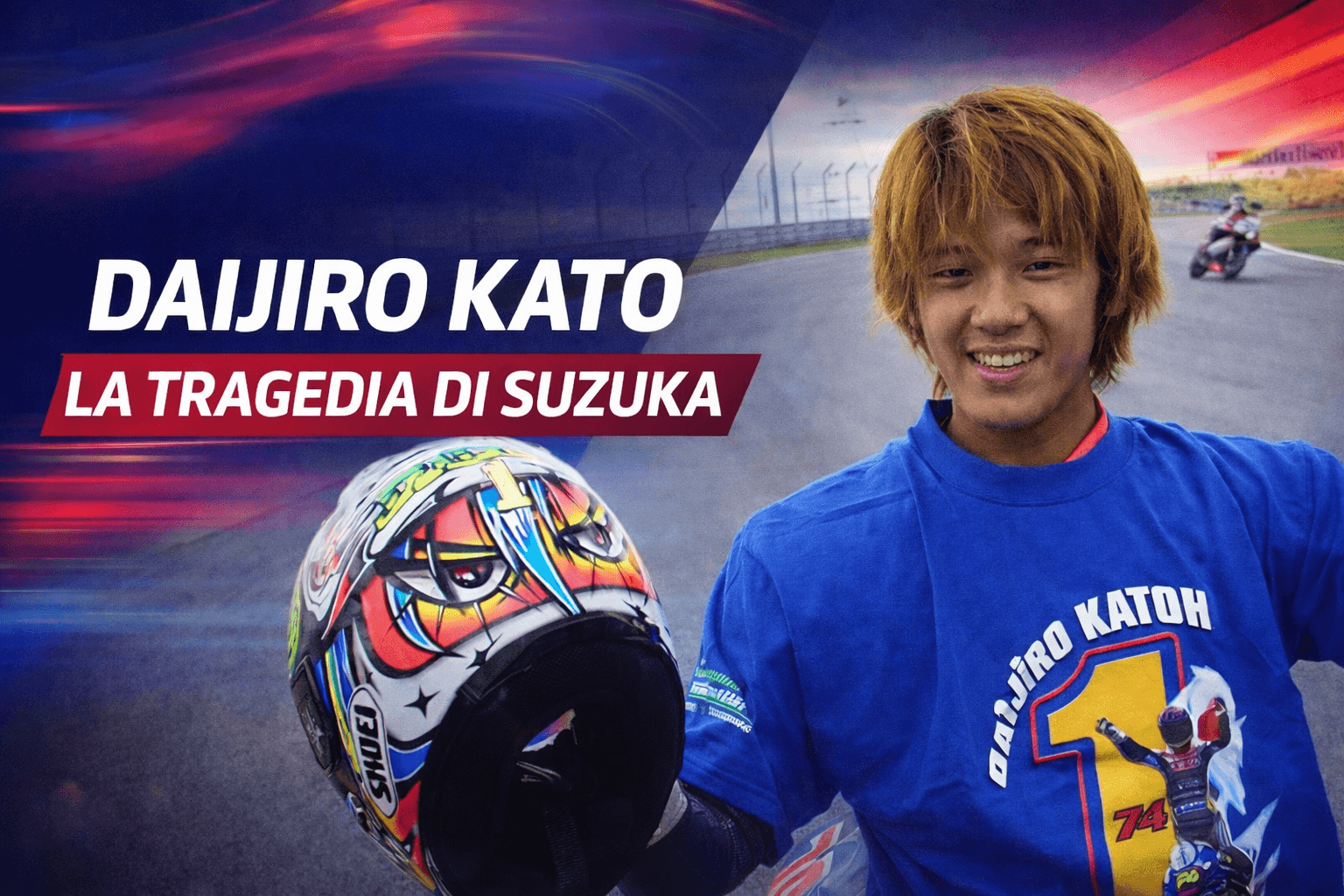
There is a moment, on track, when the noise stops being noise and becomes breath. The engine pulses, the tyres speak, the asphalt gives everything back. It is a secret dialogue, one that few know how to sustain without forcing it. Daijiro Kato kept that dialogue light, almost invisible. He did not impose it: he went with it.
Who was Daijiro Kato
Daijiro Kato was not a character. He was not looking for the spotlight, he did not raise his voice. In a paddock full of egos, he kept himself to the side. He spoke little, worked a lot. He was the opposite of the champion stereotype.
And yet, precisely for that reason, he was much loved. In Japan he represented more than a rider: he was discipline, precision, respect. An almost classical figure, built corner after corner.
Success in 250 and the arrival in MotoGP
The world title and number 74
In 2001 he won the world title in the 250 class, dominating with a naturalness that seemed simple, but was not. Number 74 became his signature: a symbol that would always accompany him.
The move to MotoGP
The step up to the premier class came with the Honda of Gresini. The RC211V is a complex bike, still to be interpreted. But Kato arrived with that rare quality of his: making everything clean, essential.
The crash at Suzuka in 2003
The home race
6 April 2003, Suzuka circuit. Not just any race. It is home, it is pride, it is expectation. The opening corners flow by quickly, the pace is high, the tension is that of the big occasion.
130R
On the third lap, in the fastest section of the circuit, something breaks. The bike becomes unsettled, loses grip. The impact is violent, into the barriers.
It is not a crash like any other. It is a moment that changes everything.
The causes and consequences
Kato is taken to Yokkaichi hospital. Head trauma, critical condition. Two weeks suspended between hope and reality. On 20 April 2003 the news arrives.
He was 26 years old.
Twenty-six. An age that in motorsport is still promise, not memory.
A different silence falls over the paddock. Not only grief, but awareness. The risk, all of a sudden, becomes real again.
Number 74 and the legacy in motorsport
Number 74 is retired. It is no longer just a number: it becomes memory. A space left empty out of respect.
Safety changes
After that crash, something changes. Barriers, procedures, attention. Not enough to erase the risk, but enough to remind everyone that every tragedy leaves a lesson.
The memory in the paddock and in Japan
Suzuka, since then, is no longer just a circuit. It is also a memory. Every pass carries an invisible trace with it.
In Japan, Daijiro Kato remains a symbol. Not only for what he won, but for how he won it.
Clean. Precise. Silent.
An interrupted trajectory
There remains an unanswered question: what would he have become?
A MotoGP champion? An even bigger icon? Perhaps yes. Perhaps no.
But what truly remains is his way of being on track. The lines, the fluidity, that technical beauty that does not need to be explained.
Because in the end, in motorsport as in life, it is not only about how fast you go. It is about how you get there.
And Daijiro Kato got there in a way that even today seems even rarer. Almost unrepeatable.