Riders' Championship
Team Championship
Constructors' Championship
Every race awards points and contributes to a standings that rewards not only those who win, but those who can be consistent throughout the season.
MotoGP bikes: technical features and performance
MotoGP bikes are prototypes designed exclusively for racing, with no production restrictions.
Engine and technical specifications
1000 cc 4-stroke engine
Different configurations depending on the constructors
Extremely rapid acceleration
Power and speed
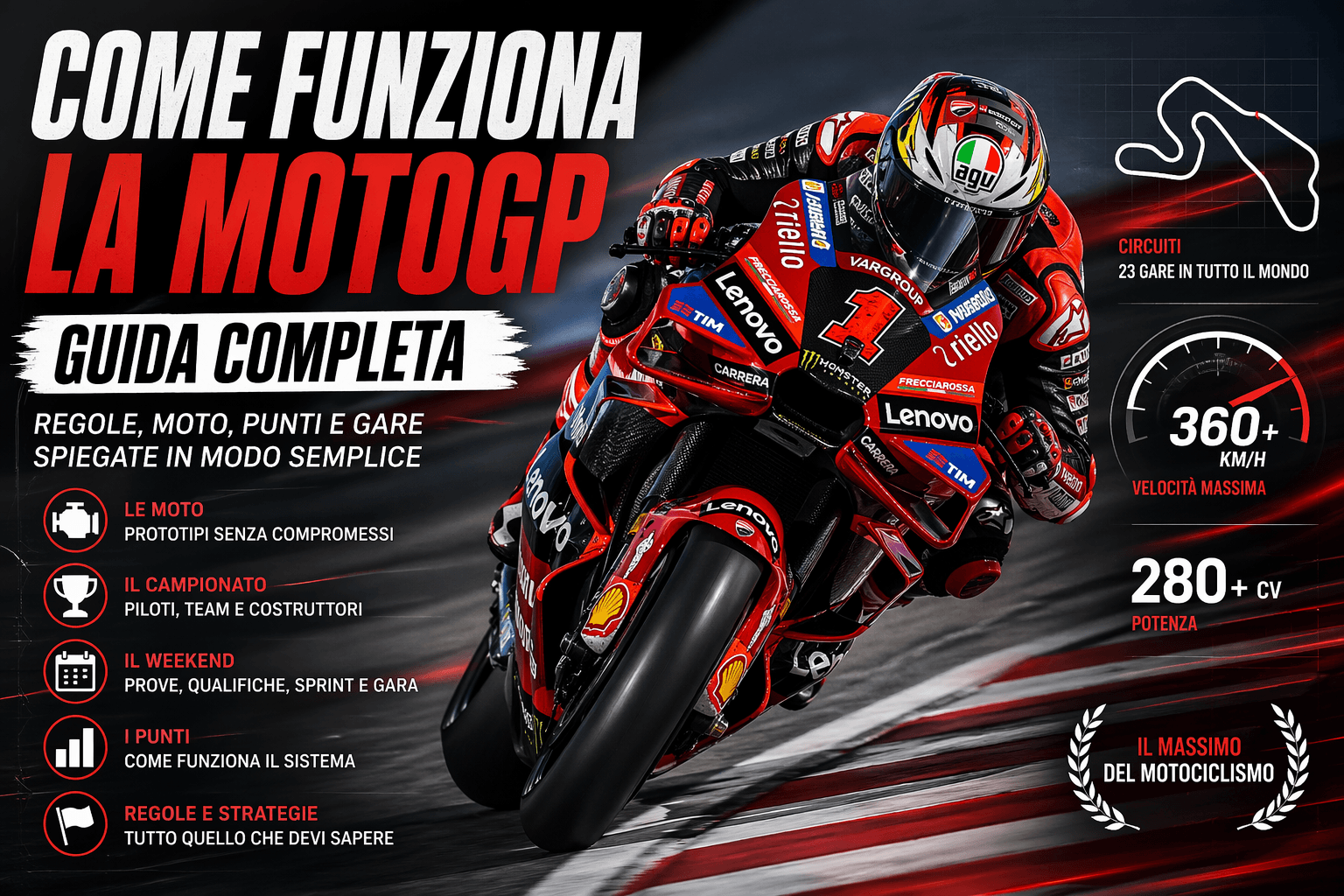
Over 280 horsepower
Speeds above 360 km/h
Differences compared with production bikes
No commercial production
Custom-developed components
Technology that cannot be replicated on the road
These are machines designed to operate constantly at the limit.
MotoGP electronics: how bike management works
Electronics are one of the most complex elements of modern MotoGP.
Traction control
It regulates power to avoid loss of grip.
Anti-wheelie
It keeps the bike stable, preventing it from lifting under acceleration.
Standard ECU
All teams use a standard ECU to ensure technical balance.
Rider's role
The rider constantly changes the settings during the race. It is active management, not automatic.
The MotoGP weekend: how it works step by step
The weekend is a progressive build-up, where each session has a direct impact on the final result.
Friday free practice
They are not just tests:
lap times matter
they determine direct access to Q2
You have to be fast straight away.
Qualifying (Q1 and Q2)
Knockout system:
Q1: riders outside the top positions try to get through
Q2: the best fight for pole position
It is the moment of pure performance.
Sprint Race
Introduced recently:
half the race distance
points for the top 9
much more aggressive pace
There is no management: only attack.
Sunday race
full distance
around 40–45 minutes
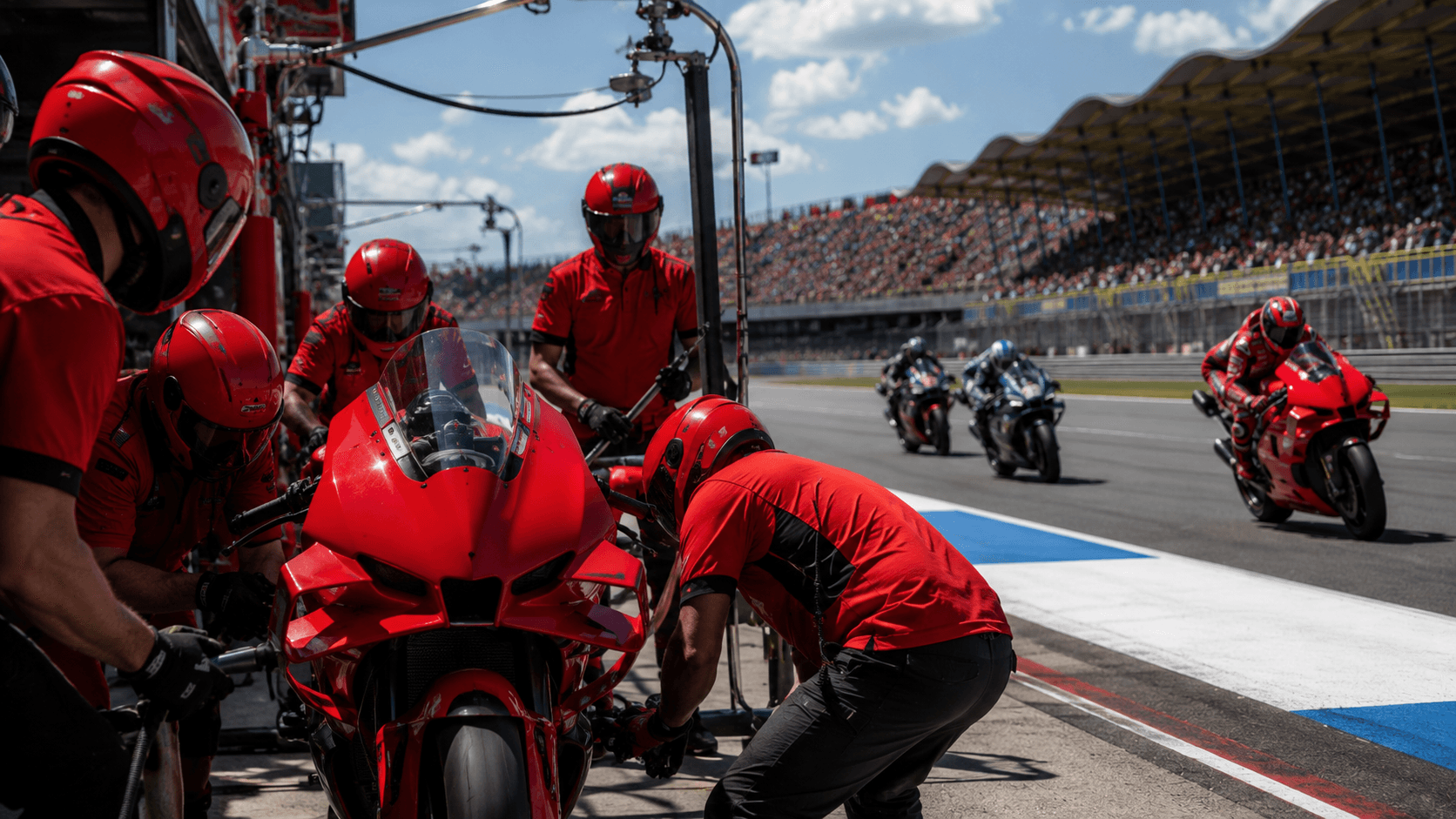
no pit stop
This is where management comes into play: tyres, pace and concentration.
MotoGP points system: how they are awarded
MotoGP rewards the top 15 riders.
Race points table
Position Points
1st
25
2nd
20
3rd
16
4th
13
5th
11
6th
10
7th
9
8th
8
9th
7
10th
6
11th
5
12th
4
13th
3
14th
2
15th
1
Sprint Race points
12 points to the winner
points down to 9th place
Standings
Riders
Teams
Constructors
Strategy in MotoGP: tyres, pace and management
Strategy in MotoGP is less visible, but fundamental.
It is based on:
tyre choice
managing degradation
adapting to track conditions
There are no pit stops: everything is decided on track, lap by lap.
Main MotoGP rules (penalties and track limits)
MotoGP is straightforward when it comes to sanctions too.
Long Lap Penalty
longer line
immediate loss of time
Track limits
Exceeding track limits carries immediate penalties.
Decisions are quick and visible.
MotoGP teams and constructors
Each constructor interprets MotoGP in its own way.
Ducati Corse → power and speed
Repsol Honda Team → aggression
Yamaha Factory Racing → smoothness
There is no single solution, and that is what makes every race unpredictable.
MotoGP vs Formula 1: the main differences
The differences are profound:
MotoGP is more physical and instinctive
No mandatory pit stop
More close duels
Greater direct intervention by the rider
It is a sport where control is always at the limit.
Frequently asked questions about MotoGP
How does MotoGP work?
It is a world championship in which riders and teams compete across multiple races, accumulating points.
What is the MotoGP Sprint Race?
A short Saturday race that awards extra points.
How many points are awarded in MotoGP?
Up to 25 points for the main race and points also for the Sprint.
How long does a MotoGP race last?
Around 40–45 minutes.
What bikes are used in MotoGP?
1000 cc prototypes designed exclusively for racing.
Conclusion
Understanding how MotoGP works means reading a sport where technique and instinct constantly coexist.
It is not just speed. It is management, sensitivity, adaptation. It is the ability to stay at the limit without going over it.
And it is precisely this balance that makes MotoGP one of the most intense and spectacular competitions in world motorsport.