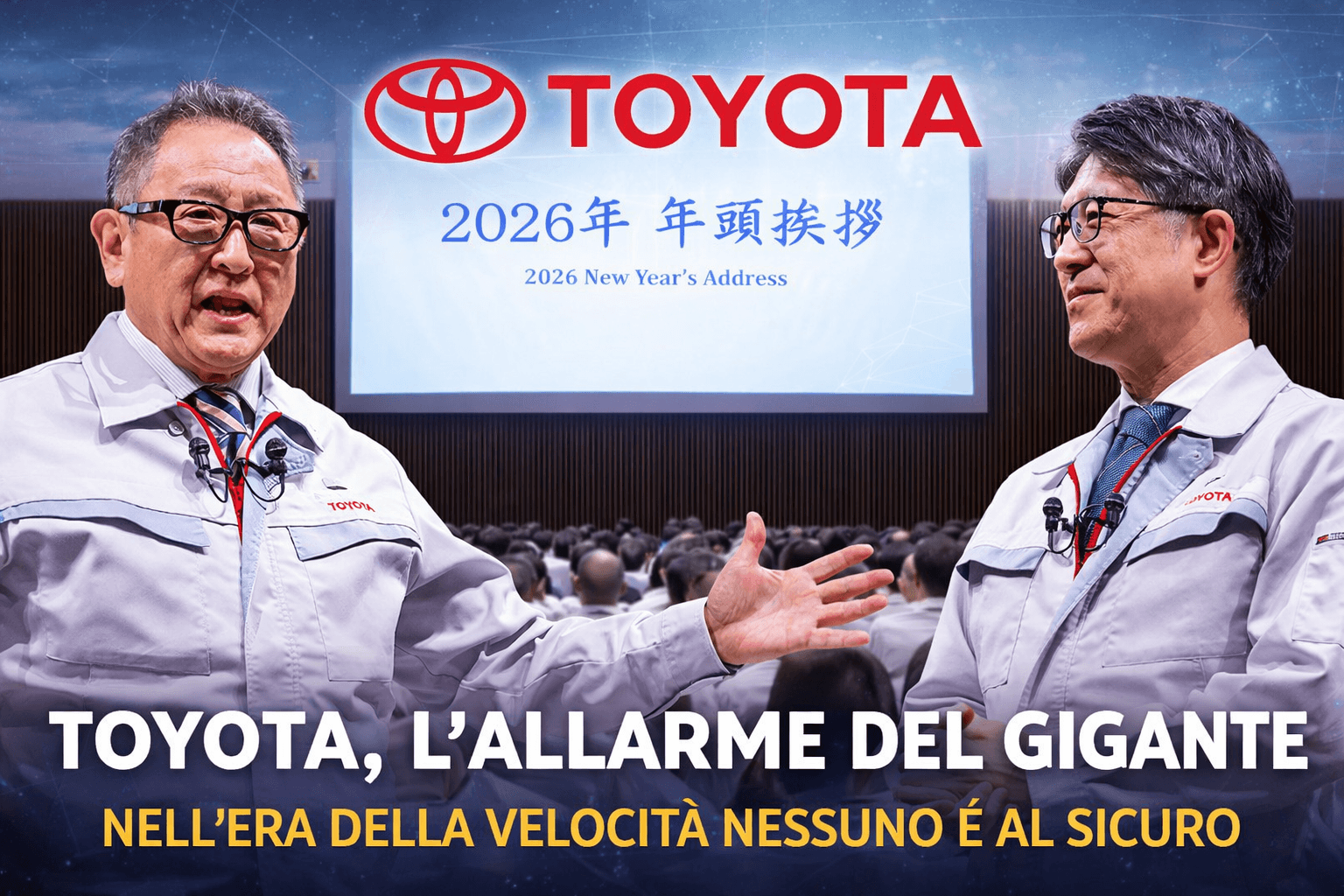
This is not management rhetoric. It is the summary of an epochal transformation that is overwhelming the entire automotive sector — and, by extension, any traditional industry.
The crisis that cannot be seen in the numbers
Paradoxically, Toyota is not in difficulty... at least on paper.
Over 11 million vehicles sold
Record profits in recent years
Consolidated global leadership
Yet, behind these numbers, lies a growing tension: the model that made Toyota dominant is no longer enough for the future.
The change at the top — with the departure of Koji Sato and the arrival of CFO Kenta Kon — is not just a management reshuffle. It is a strategic signal: from the centrality of engineering to the centrality of financial discipline and decision-making speed.
The real shock: Toyota is slowing down while the world accelerates
To understand the scale of the problem, we need to look beyond Japan.
Over the last three years, the automotive industry has undergone a radical transformation:
China produces over 60% of global electric vehicles
Players like BYD are overtaking Western rivals in volumes and costs
Software has become the heart of the car
It is no longer just about building cars. It is about building digital platforms on wheels.
And here the real gap emerges.
Toyota, but also many of the traditional manufacturers, is moving with industrial cycles designed for an analogue world. The new competitors, meanwhile, operate with tech company logic: rapid iteration, vertical integration, continuous software development.
When quality becomes a problem
The most controversial point — and perhaps the most revealing — concerns the review of quality standards.
Toyota has launched a programme to eliminate overly rigid specifications that increase costs without really improving the final product.
For decades, the mantra was: zero defects, always.
Today it becomes:
zero waste, even at the cost of accepting invisible imperfections
It is a huge cultural shift.
According to what emerged from meetings with suppliers, many inefficiencies stemmed precisely from too much control: production lines stopped, delays, unnecessary costs.
In other words:
the very obsession with quality that built the Toyota myth is beginning to slow it down.
The invisible war: supply chain, software and raw materials
Competition is no longer played out solely on the final product.
Toyota is trying to reorganise itself on several fronts at once:
Access to lithium and rare earths, in direct competition with China
Reduction of the break-even point to survive lower margins
Standardisation of software and hardware platforms
Greater integration with suppliers
The message to partners was direct: increase productivity and innovation, or be left behind.
It is a paradigm shift: from a stable and optimised network to a dynamic ecosystem under pressure.
The Toyota paradox: being right too early (or too late)
There is an even more interesting element.
Toyota never fully believed in the rush towards pure electric. It focused on a multi-technology strategy (hybrid, hydrogen, electric).
Today this choice is proving to be both an advantage and a limit:
✔ It has maintained profitability thanks to hybrids
✖ It is behind on software and pure EVs
Meanwhile, rivals have optimised costs and technologies around a single direction.
The result?
Toyota is solid, but slower.
And in 2026, being slower means being vulnerable.
It is not just Toyota: it is the end of an industrial era
The Toyota case is emblematic because it represents the highest point of the twentieth-century industrial model.
Efficient production
Optimised processes
Total quality
That model is not dead. But it is no longer enough.
Today competitive advantage is built on other axes:
Development speed
Software capability
Access to critical resources
Organisational flexibility
And above all: the ability to change continuously
The most uncomfortable lesson
There is a conclusion that goes beyond automotive.
If even Toyota — a global symbol of operational excellence — has to question its own fundamental principles in order to survive, then no model is untouchable.
There is no longer:
the stable sector
the permanent advantage
guaranteed leadership
There is only one question:
how quickly are you willing to change what made you successful?
Epilogue: from Kaizen to “radical Kaizen”
For decades, Toyota taught the world continuous improvement.
Today it seems forced to do something harder:
improve by changing the rules of improvement itself.
Not more small incremental steps.
But deep, even painful, overhauls.
It is the shift from Kaizen to a new form of evolution:
faster, less perfect, inevitably riskier.
But perhaps that is exactly the point.
In 2026, it is not the perfect who survive.
It is those willing to stop being perfect in time.DEVELOPER MODE