At Milan Design Week 2026, Maserati's most extreme car of recent years makes its debut
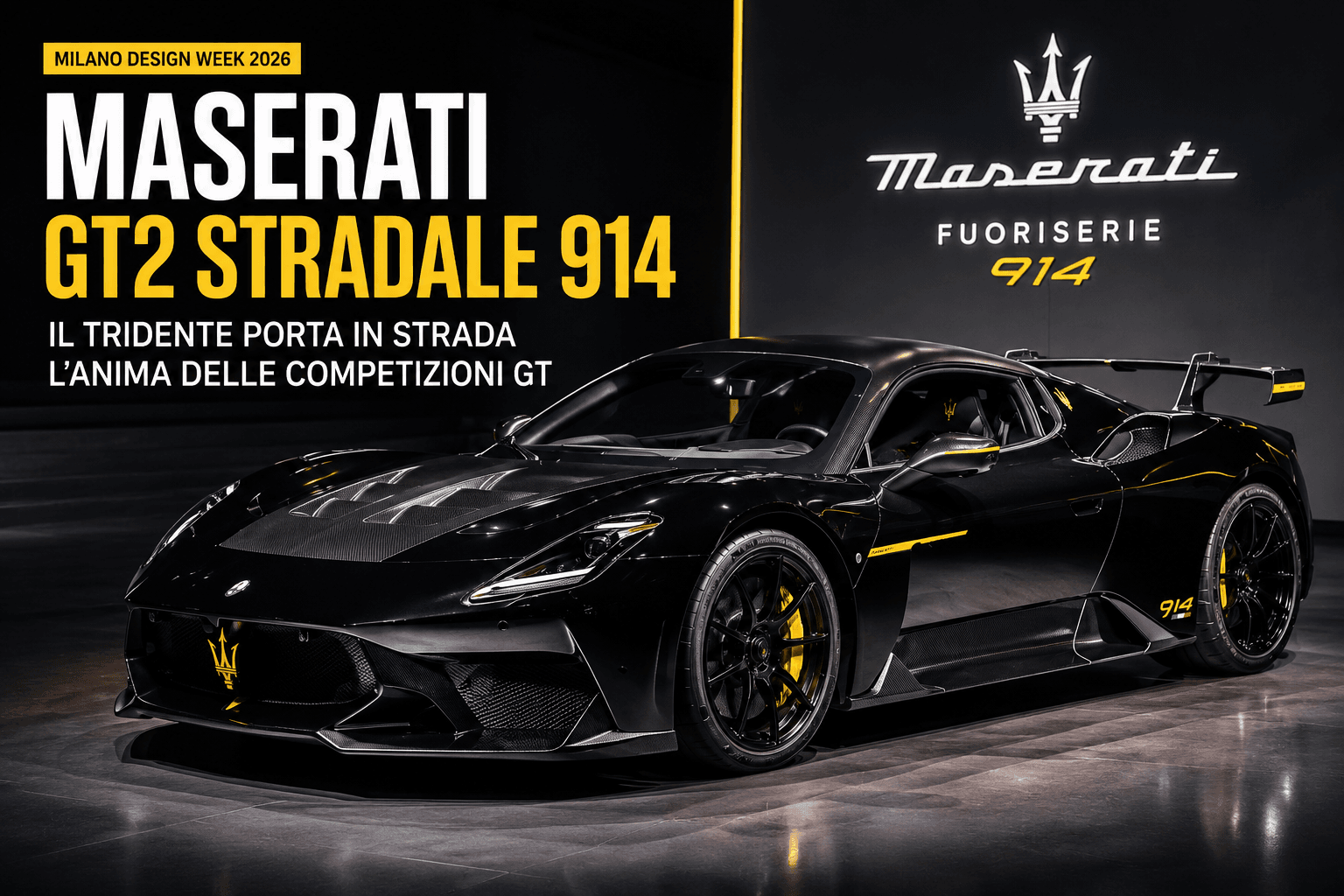
Milan once again turns into the world capital of design, but this time the spotlight is not on architecture and furniture alone. At Design Week 2026 it was Maserati that captured the attention of enthusiasts with the new GT2 Stradale Fuoriserie 914, a one-off that takes the concept of an artisanal supercar to the extreme.
The Trident brand chose the Milan stage to show the most exclusive face of the Fuoriserie programme, presenting a model that comes directly from the experience gained in GT motorsport. The result is a car that seems to have come straight out of the paddock of an endurance championship, but with the elegance and refinement typical of Made in Italy.
The GT2 Stradale 914 is not just a show car destined to impress during an international event. Maserati conceived it as a technological and stylistic manifesto of the brand's new era, increasingly oriented towards bespoke production and highly personalised supersports cars.
Aggressive design and racing details: the GT2 Stradale looks born for Le Mans
Carbon fibre, aerodynamics and yellow details: the signature of the Fuoriserie 914
One glance is enough to understand that this Maserati belongs to a different category. The Nero Essenza bodywork enhances the taut, sculpted lines of the GT2 Stradale, while the Giallo Avia Pervia inserts immediately recall the world of racing.
The low, sharp front end dominates the scene with enlarged air intakes and a pronounced splitter, designed to increase aerodynamic downforce. On the bonnet, the exposed carbon fibre surfaces stand out, a solution that is not only aesthetic but also contributes to reducing overall weight.
The fixed rear wing is probably the most spectacular element of the entire car. Imposing, extreme, almost brutal, it clearly conveys the racing origins of the project. Maserati worked on aerodynamic efficiency following the philosophy of GTs entered in endurance races, bringing to the road a level of downforce rarely seen on a Trident car.
The black multi-spoke wheels and the braking system with yellow callipers also help reinforce the motorsport character of the 914, turning it into one of the most aggressive Maseratis ever made.
Nettuno 640 CV engine: the most powerful combustion Maserati ever
Performance of a true race car homologated for the road
Beneath the bonnet beats the 3.0-litre twin-turbo V6 Nettuno, the technological heart of the new Maserati generation. In this configuration the GT2 Stradale reaches 640 CV, effectively becoming the most powerful internal-combustion Maserati ever homologated for road use.
The performance perfectly captures the extreme nature of the car. The 0 to 100 km/h sprint takes less than three seconds, while the top speed comfortably exceeds 320 km/h. Numbers that place the GT2 Stradale among the most radical supersports cars currently on the European market.
Much of the work was also focused on weight. Thanks to the extensive use of carbon fibre and a technical setup derived directly from the racing GT2, Maserati managed to significantly improve agility and steering precision.
The drivers involved in the car's development spoke of behaviour extremely close to that of the racing version, highlighting above all the precision of the front end and the car's ability to remain stable even under the heaviest braking. An aspect that confirms how the GT2 Stradale is not simply a high-performance grand tourer, but a true track car adapted for road use.
Minimalist interior and racing atmosphere
The GT2 Stradale's cockpit is all about driving
Inside, the atmosphere changes radically compared with traditional Maserati grand tourers. The GT2 Stradale 914 gives up any superfluous excess to make room for an essential, sporty setup.
Black Alcantara, carbon fibre and yellow details coordinated with the bodywork dominate. The race bucket seats immediately convey the feeling of being inside a car built to lap around the kerbs, while the sports steering wheel and lowered driving position further increase engagement.
Despite the extreme setup, Maserati has still maintained high standards of finish and build quality, an element that continues to set the Modena marque apart within the landscape of Italian supersports cars.
Maserati's strategy goes through the Fuoriserie programme
Tailor-made luxury and total customisation to relaunch the Trident
Behind the debut of the Fuoriserie 914 lies a very precise strategy. Maserati wants to strengthen its positioning in the luxury segment by focusing on exclusivity and extreme personalisation.
The new Bottega Fuoriserie division was created precisely for this: to offer customers the chance to create unique cars, developed as genuine pieces of automotive haute couture. Materials, colours, finishes and details can be configured with practically no limits, turning every Maserati into a one-off.
The GT2 Stradale 914 therefore represents much more than a simple styling exercise. It is the symbol of a brand that wants to return to the forefront both in motorsport and in the world of luxury supercars, leveraging the appeal of Italian design and the know-how gained in competition.
With this car, the Trident sends a clear message to the market: Maserati wants to return to being a benchmark among the most emotional and refined sports cars on the international scene.