The 1994 San Marino Grand Prix is remembered as the most tragic weekend in Formula 1 history. At the Autodromo Enzo e Dino Ferrari circuit, between 29 April and 1 May, a sequence of crashes unfolded that shocked world motorsport, leading to radical changes in safety.
What happened at Imola in 1994
The race weekend began like any other round of the World Championship, but quickly turned into a nightmare. Three days marked by ever more serious crashes, culminating in the deaths of two drivers.
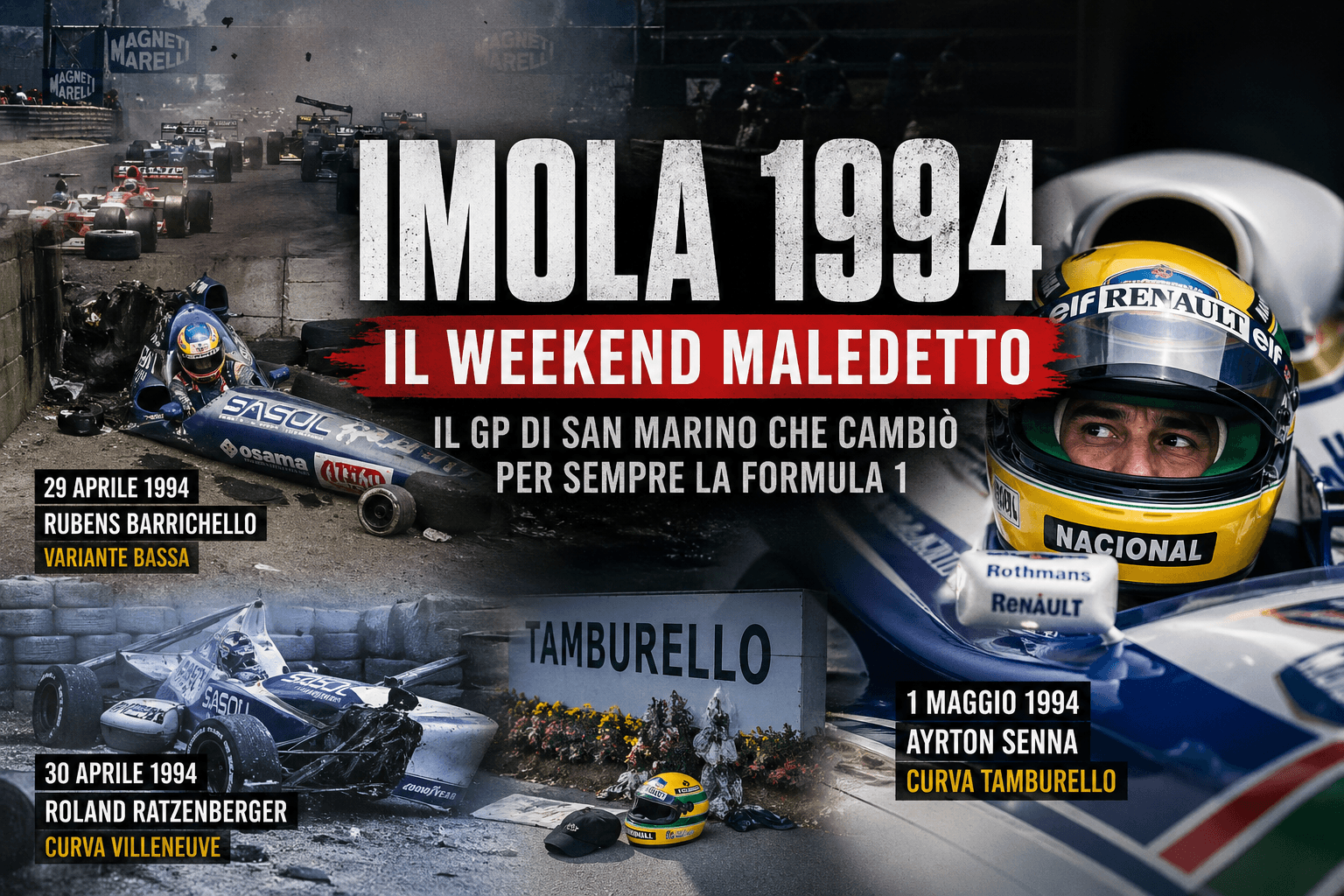
Friday 29 April: the crash of Rubens Barrichello
During free practice, the young Brazilian loses control of his car at the Variante Bassa.
Dynamics of the crash
Violent impact against the barriers
The car goes airborne
Driver unconscious for a few moments
Barrichello survives, but the episode is the first warning sign of a weekend destined to deteriorate.
Saturday 30 April: the death of Roland Ratzenberger
Qualifying day marks a historic tragedy for Formula 1.
What happened
Front wing failure on the Simtek
Loss of control at over 300 km/h
Fatal impact at the Villeneuve corner
Ratzenberger's death ends a run of fatal accidents that had lasted for more than a decade. Silence falls in the paddock.
Among the hardest hit is Ayrton Senna, then a Williams F1 Team driver, deeply shaken by what happened.
Sunday 1 May: the tragedy of Ayrton Senna
Race day becomes the darkest in Formula 1 history.
Chaotic start
An incident at the start scatters debris across the track and also involves the crowd. The race is temporarily neutralised.
The Tamburello crash
On the seventh lap:
Senna's Williams leaves the track
High-speed impact against the wall
Immediate rescue but critical condition
A few hours later, confirmation arrives: Ayrton Senna has died. The world of sport comes to a halt.
Consequences of the 1994 San Marino Grand Prix
The 1994 San Marino Grand Prix represents a watershed moment for safety in Formula 1.
Changes introduced
Structural modifications to circuits
Reduction in speeds
Improvements in car safety systems
Introduction of new FIA regulations
These measures have helped make modern Formula 1 much safer.
The legacy of Imola 1994
Today, every Formula 1 race carries the legacy of that tragic weekend. The names of Roland Ratzenberger and Ayrton Senna remain indelible symbols of a necessary change.
Their loss has saved lives in the years since.
Why Imola 1994 is still so important
It revolutionised safety standards
It marked the end of an era
It changed Formula 1's mindset
The weekend of 1 May 1994 is not just a tragedy: it is the turning point that has made this sport safer for everyone.