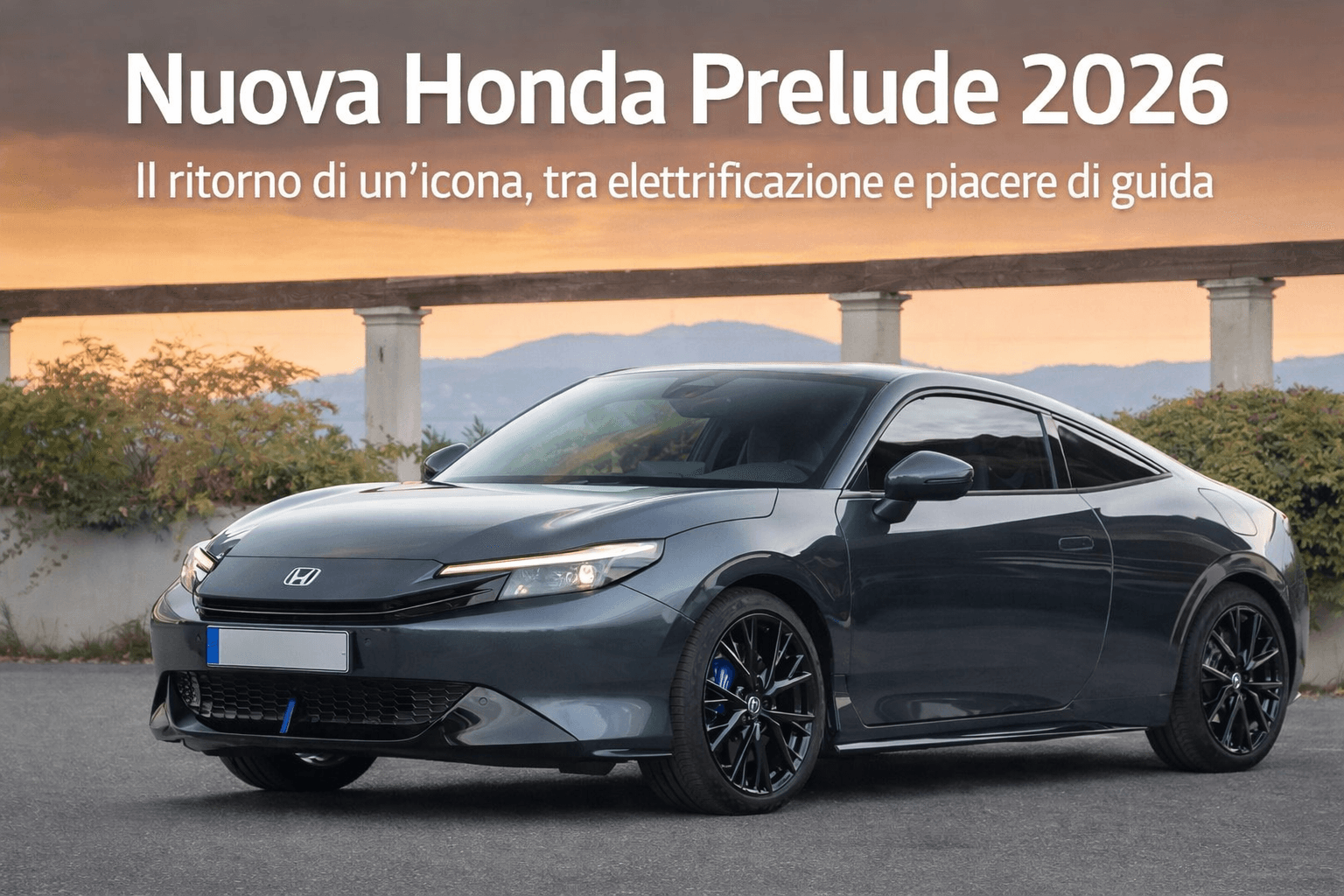
Long bonnet and sleek profile
Short rear with a fastback layout
Low stance and wide track
Wheels up to 19 inches and aerodynamic details
The result is an elegant but dynamic car, closer to a compact GT than to a pure sports car. The platform is partly derived from the Civic's technical base, with elements taken from the more performance-oriented version.
Engine and technology: hybrid yes, but with character
At the heart of the Prelude 2026 is a next-generation full hybrid e:HEV system:
Engine 2.0-litre Atkinson petrol
Two electric motors
Combined power: around 200 hp
Torque: around 232 lb-ft (≈315 Nm)
Drive: front-wheel drive
Gearbox: e-CVT
Unlike traditional sports cars, the combustion engine often works as a generator, while propulsion is mainly handled by the electric unit.
S+ Shift: the “fake” sportiness that works
The S+ Shift system makes its debut, simulating gear changes and the behaviour of a sporty gearbox:
Paddles on the steering wheel
Simulation of downshifts and throttle blipping
Greater driver involvement
An intelligent solution to compensate for the absence of a manual gearbox.
Chassis and dynamics: the Type R has a hand in it
One of the most interesting aspects is the chassis:
Components derived from the Civic Type R
Double-axis front suspension
Larger brakes (including Brembo)
Adaptive dampers
The result? Precise, neutral and surprisingly engaging driving, while still remaining accessible in everyday use.
Interior and technology
4
The cabin is a mix of sportiness and comfort:
2+2 layout
Digital instrument cluster with 10,2”
Infotainment of around 9”
Bose audio system
Sports seats and D-shaped steering wheel
Perceived quality is good, with a layout clearly focused on the driver.
On the road: numbers and sensations
The Prelude is not chasing records, but balance:
0-100 km/h: about 7,2 seconds
Fuel consumption: up to about 5,2 l/100 km
Range: up to 760 km
It is a “thoughtful” sports car: smooth, efficient and enjoyable, rather than brutal.
History: the five generations of the Prelude
The Prelude was born in 1978 and went through five generations:
1978–1982: elegant coupé derived from the Accord
1982–1987: pop-up headlights and a more aggressive style
1987–1991: introduces the revolutionary 4WS (four-wheel steering)
1991–1996: technical and dynamic maturity
1996–2001: peak with VTEC engine and sporting vocation
After 2001, the Prelude disappears from the scene, crushed by the decline in interest in coupés.
Rivals: who challenges the new Prelude?
The Prelude 2026 enters an increasingly rare niche: compact coupés.
Direct rivals and alternatives:
Toyota GR86 → purer and more analogue
Subaru BRZ → similar to the GR86
Audi TT → more refined (but out of production)
BMW Serie 2 Coupé → more powerful and more expensive
Mazda MX-5 → a lighter and more fun alternative
The Prelude is playing a game of its own: hybrid, accessible and technological, against more traditional rivals.
Technical sheet – Honda Prelude 2026
Item Data
Engine
2.0L 4 cylinder + 2 electric motors
System
Full Hybrid e:HEV
Power
~200 hp
Torque
~315 Nm
Transmission
e-CVT
Drive
Front-wheel drive
0-100 km/h
~7,2 s
Fuel consumption
~5,2 l/100 km
Length
4.525 mm
Width
1.880 mm
Height
1.349 mm
Seats
4 (2+2)
Range
up to ~760 km
Conclusions
The new Prelude is not a nostalgic return for its own sake. It is a statement of intent: to show that even in the era of electrification, driving pleasure is still possible.
It may not be the fastest or the most extreme, but it is probably one of the smartest and most original offerings on the current market.
In a world dominated by SUVs, the Prelude is a pleasant anomaly. And perhaps precisely for that reason, one of the most interesting cars of 2026.