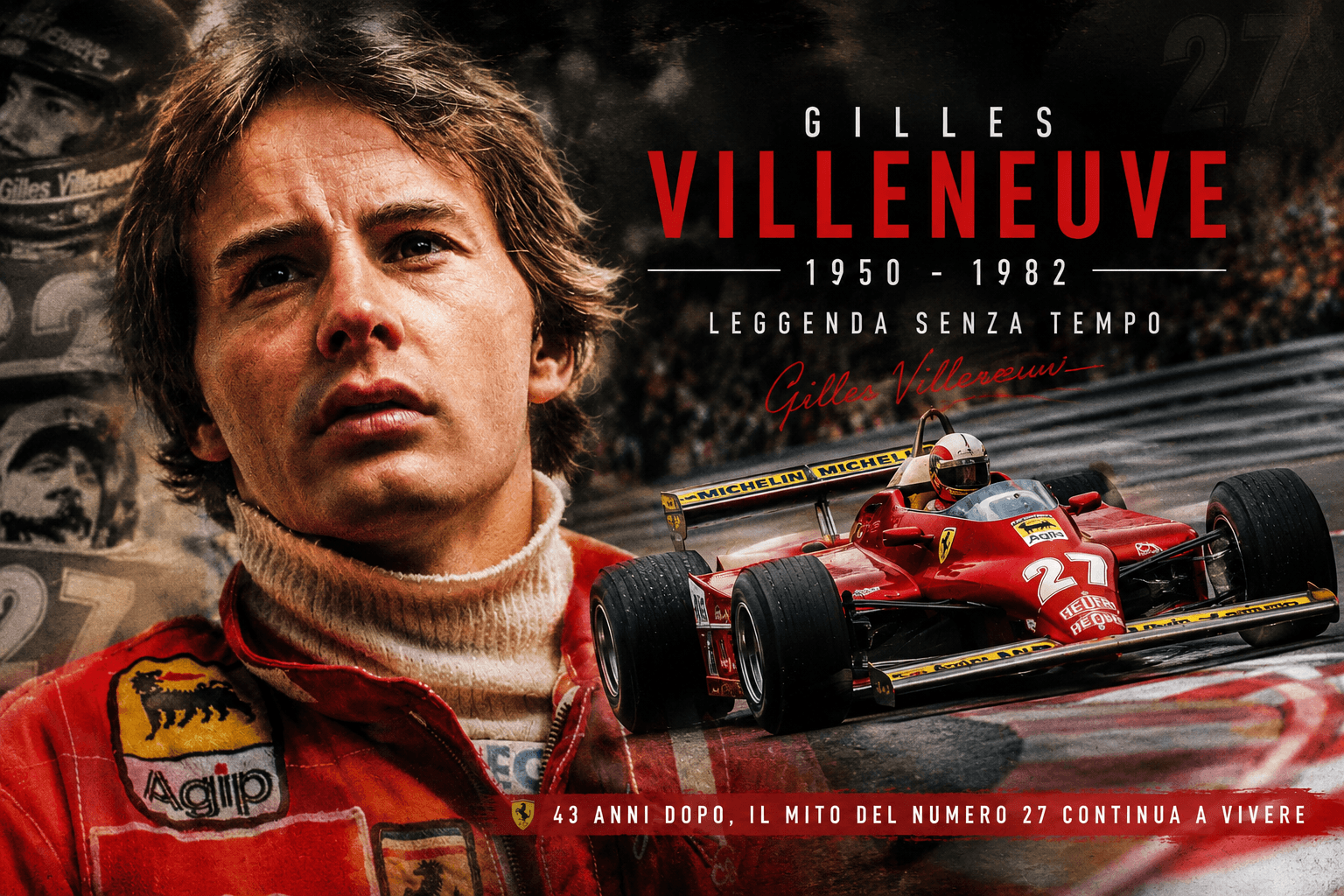
The Ferrari number 27 flew into the air during qualifying for the Belgian Grand Prix. A violent, unnatural impact. A few seconds. Then silence. One of those silences that only rarely come in sport. And when they do, they stay forever.
Villeneuve was 32 years old.
He still had hunger. Anger. Speed.
Above all, he had that childlike stubbornness of the predestined. The kind who cannot accept compromise. Even when compromise might save your life.
Gilles Villeneuve and Ferrari: an irregular and perfect love story
Enzo Ferrari immediately saw something the others did not understand
When Enzo Ferrari chose him, many thought it was madness. Gilles came from Canada, from snowmobiles, from tracks dirty with ice and snow. He drove as if every corner were a personal challenge.
He was not tidy.
He was not strategic.
He was not prudent.
He was alive.
And Ferrari, who had known enough men to understand certain things straight away, saw in that slender boy something that resembled the drivers of another era. The ones who raced more with their heart than with their brain.
Villeneuve did not drive the Ferrari.
He dragged it along.
He took it where often even the car could not go. That is why Maranello loved him immediately. That is why even today the number 27 is not just a number. It is a symbol.
Dijon 1979: when Formula 1 became poetry
The duel with René Arnoux remains the manifesto of real racing
To understand Gilles Villeneuve, numbers are not needed. Just look at Dijon 1979.
The final laps against René Arnoux belong to that category of images that explain on their own what sport is. Wheel-to-wheel contact, wheels brushing, cars out of control and two men unable to give in.
Today it would be almost unthinkable.
Back then it was Formula 1.
Villeneuve raced like that: without calculating the risk, without protecting himself too much from mistakes. He sought something that resembled perfection but that, in reality, was much more human. He sought absolute emotion.
And anyone watching him immediately understood one thing: Gilles was not simply driving. Gilles was consuming himself.
Imola, Pironi and that wound that never healed
The betrayal Villeneuve could not accept
Two weeks before Zolder there had been Imola.
And above all there had been Didier Pironi.
Villeneuve felt betrayed. Not in sporting terms. Humanly. Because Gilles belonged to an old Formula 1, made up of words that still had weight. He believed in agreements between men. He believed in loyalty.
When Pironi passed him in the closing stages of the San Marino Grand Prix, something broke definitively.
Those close to him say dark days. Long silences. Bottled-up anger. Villeneuve arrived in Belgium with one goal: to be the fastest of all.
As if speed could heal pride.
Why Gilles Villeneuve is still Ferrari's most loved driver today
No world champion, but an eternal legacy in Formula 1
Modern Formula 1 measures everything. Times, data, tyre wear, risk management.
Villeneuve instead belonged to an imperfect and romantic motorsport. A world where the driver still inspired fear. First in others. Then in himself.
Perhaps that is why his name continues to withstand time.
He did not win a world championship.
And yet few drivers are remembered like him.
Because Gilles Villeneuve does not represent success. He represents something much rarer in modern sport: authenticity.
He was fragile. Instinctive. At times even reckless beyond what was necessary. But inside that fragility there was an absolute sincerity that the public immediately perceived.
Villeneuve did not play the role of the driver.
He truly was one.
The myth of Villeneuve beyond time
Today his name lives in Montréal, at the circuit that bears his name. It lives in faded photographs hung in workshops. It lives in the stories of old Ferrari fans who still lower their voices when they speak of him.
And above all it lives in that collective nostalgia for a Formula 1 that perhaps no longer exists.
A dirty, dangerous, human Formula 1.
A Formula 1 where a Canadian boy managed to become immortal simply by driving harder than fear.