There are:
10 teams (constructors)
20 drivers
Each race awards points valid for two standings:
Drivers’ Championship
Constructors’ Championship
It is a continuous competition: while racing, the car is being developed; while battling on track, developments are being planned for the next race.
Technical regulations: how F1 hybrid engines work
The heart of modern Formula 1 is the so-called Power Unit, a hybrid system among the most advanced in the world.
What is the Power Unit
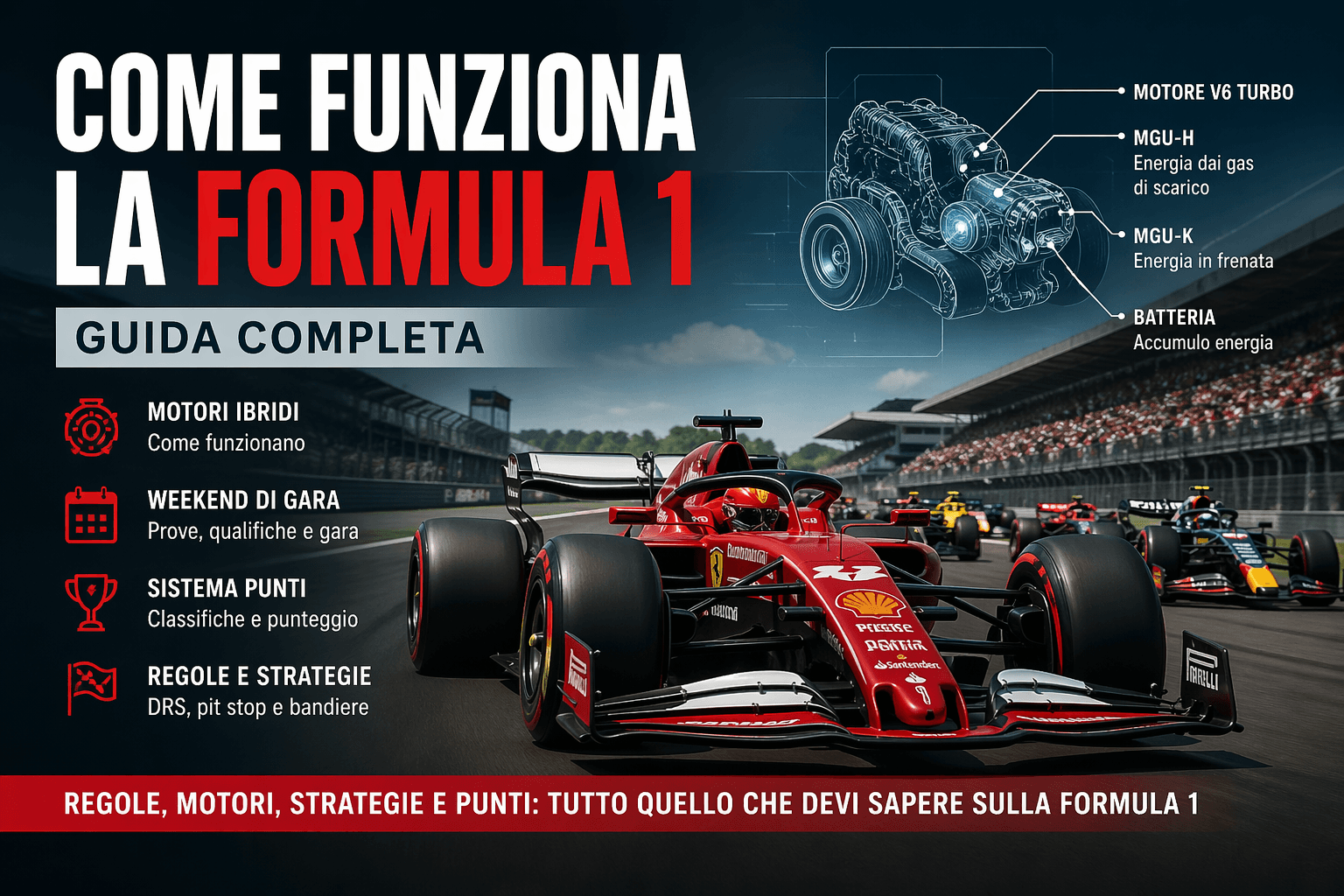
It is not a simple engine, but an integrated set of components:
ICE (1.6-litre turbo V6 combustion engine)
MGU-K (energy recovery under braking)
MGU-H (energy recovery from exhaust gases)
Battery (Energy Store)
Electronic control unit
This system makes it possible to recover energy that would otherwise be lost and turn it into power. Efficiency exceeds 50%, an extraordinary figure in the automotive world.
In performance terms, the overall power exceeds 1000 horsepower, with extremely sophisticated management from the driver.
How energy recovery works
During the race:
Under braking, the MGU-K turns kinetic energy into electrical energy
From the exhaust gases, the MGU-H recovers thermal energy
The energy is stored and reused
The driver decides when to use this energy, for example to defend or attack.
Regulatory limits and penalties
The regulations impose:
A limited number of components per season
Control over fuel consumption
Standardised technical specifications
Exceeding these limits leads to grid penalties, often decisive ones.
2026 regulation changes
From 2026:
Removal of the MGU-H
Greater use of electrical energy
100% sustainable fuels
A change that will profoundly affect strategy and performance.
The Formula 1 race weekend: full structure
A Grand Prix is a process built step by step.
Free practice (FP1, FP2, FP3)
Friday and Saturday morning are dedicated to preparation.
The teams work on:
Aerodynamic set-up
Car balance
Tyre degradation
Race simulations
Every lap produces fundamental data.
Qualifying (Q1, Q2, Q3)
The starting grid is decided on Saturday afternoon.
Format:
Q1: the 5 slowest are eliminated
Q2: another 5 are eliminated
Q3: the best 10 fight for pole position
It is the moment of pure performance, without compromise.
Race: distance, duration and rules
The race is held on Sunday:
Around 305 km in distance
Maximum duration: 2 hours
Standing start
During the race:
Compulsory use of at least two tyre compounds (in dry conditions)
Strategic pit stops
This is where everything comes together: speed, strategy and management.
Formula 1 points system: how points are awarded
The scoring system rewards the top 10.
PositionPoints
1st
25
2nd
18
3rd
15
4th
12
5th
10
6th
8
7th
6
8th
4
9th
2
10th
1
Point for fastest lap
An extra point is awarded to the driver who sets the fastest lap, if he finishes in the top 10.
Difference between drivers and constructors
Drivers’ Championship → individual points
Constructors’ Championship → sum of the two drivers’ points
The latter has a huge economic impact on the teams.
Strategy and pit stops: how races are won
Speed is only part of the equation.
The tyres, supplied by Pirelli, determine race pace:
Soft → faster, less durable
Medium
Hard → slower, more durable
Pit stop timing is decisive. Stopping at the wrong moment can ruin the whole race.
Added to this are:
Traffic on track
Safety Car
Tyre degradation
The pit wall works like an operations centre, working on strategies in real time.
Main track rules (DRS, flags and penalties)
The race is governed by a precise system.
DRS → system to facilitate overtakes
Safety Car → neutralises the race
Virtual Safety Car → controlled slowing-down
The flags:
Yellow → danger
Red → race suspended
Blue → obligation to let others through
Every infringement can lead to a penalty, affecting the final result.
The teams and drivers: how Formula 1 is organised
Teams such as Scuderia Ferrari, Mercedes-AMG Petronas Formula One Team and Red Bull Racing represent highly specialised structures.
Every department is fundamental:
Aerodynamics
Power unit
Strategy
Simulation
The driver is the final link in an extremely complex system.
The role of the driver: total management
The driver must:
Manage tyres and fuel
Control hybrid energy
Communicate with the team
The steering wheel is an advanced command centre. The physical demands are extreme, with high G-forces and very high temperatures.
Frequently asked questions about Formula 1
How does qualifying work in Formula 1?
It is split into three knockout sessions (Q1, Q2, Q3) that determine the starting grid.
How many points are awarded in F1?
The top 10 receive points, with 25 for the winner.
How long does a Formula 1 race last?
Around 305 km or a maximum of 2 hours.
How do hybrid engines work?
They combine a combustion engine and electrical systems that recover energy.
What is DRS in Formula 1?
A system that reduces aerodynamic drag to facilitate overtakes.
Conclusion
Formula 1 is much more than a race. It is a complex system where regulations, hybrid technology, strategy and talent are constantly intertwined.
Understanding how Formula 1 works means interpreting every detail: from tyre choices to energy management, from the structure of the weekend to the scoring system.
It is in these details, often invisible, that victories are decided and championships are built.