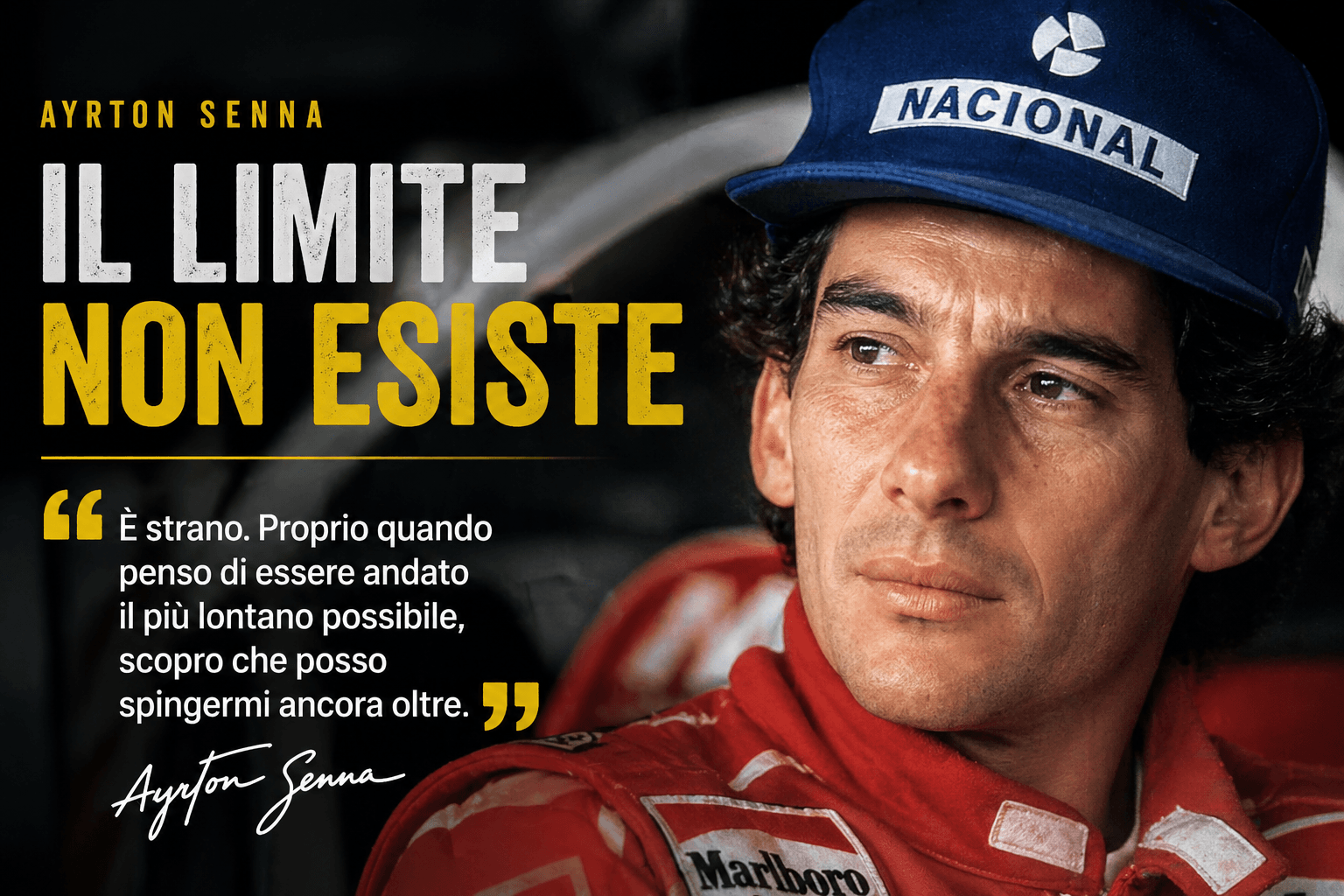
“When I think I have arrived, I discover that I can go beyond”
There is a thin, invisible line that separates ordinary men from those who decide to challenge the impossible. Ayrton Senna did not see that line. He crossed it.
“It is strange. Just when I think I have gone as far as possible, I discover that I can push myself even further.”
It is not a phrase. It is a confession. It is the short breath inside a helmet, it is the rain falling on Circuit de Monaco, it is a lap that should not exist and yet happens.
Ayrton Senna and the meaning of the limit in Formula 1
In the language of Formula 1, the limit is a number: speed, grip, telemetry.
For Senna, no. The limit was a mental place. Unstable. Fragile. Surpassable.
He was not just driving a car. He was entering a dimension where time stretches, where every corner is a question and every answer arrives too late. Or perfectly so.
Three world titles. Numbers, indeed. But reductive.
Because Senna is not measured: he is perceived.
The legend of Senna between speed, faith and obsession
There was something different. An almost religious tension.
Senna often spoke of God, but on track he was in dialogue with risk.
He was not looking for total control. He was looking for the point where control ends.
That is where the legend is born:
in the rain at Donington
in the unreal silence before the start
in those tenths snatched from what was possible
And every time, that feeling: “I have arrived”.
Right after: no, not yet.
Why Ayrton Senna's phrase is still current
Today Formula 1 is algorithms, simulations, surgical precision.
And yet, that phrase continues to circulate.
Because it speaks to everyone:
to drivers chasing thousandths
to athletes searching for the margin
to anyone who has brushed against a limit thinking it was final
Senna suggests something else: the limit is a belief, not a reality.
Ayrton Senna's legacy in modern motorsport
It is not nostalgia. It is presence.
Every time a driver risks something extra, every time a braking point comes a metre later, there is an echo. Not visible, but recognisable.
Senna did not teach how to drive.
He showed why you drive.
And perhaps that is the point.
Not arriving. Not winning.
But continuing to look for that boundary, knowing that, as soon as you touch it, it is already further ahead.