The viral news that is fuelling debate in the paddock
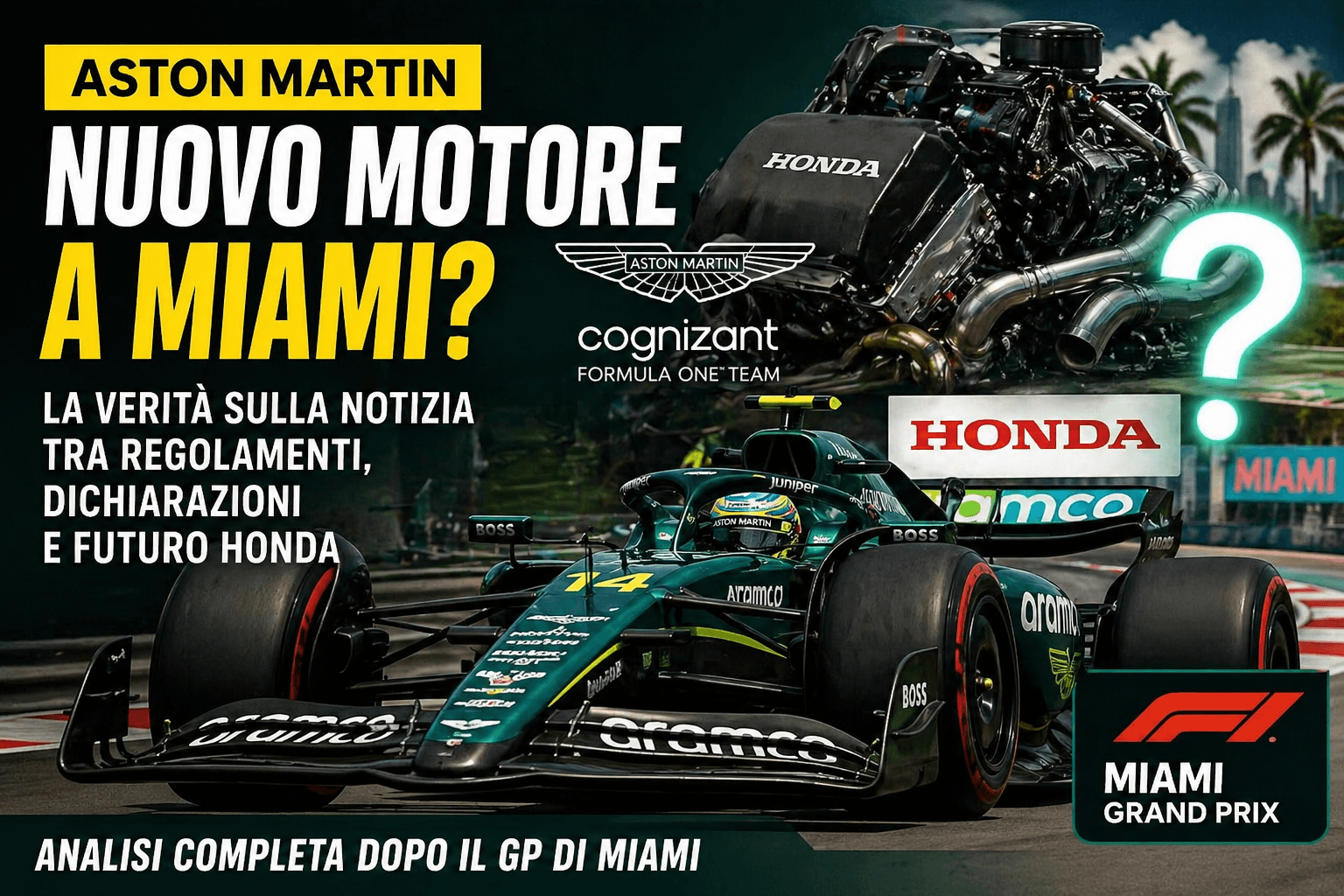
In the middle of the Miami Grand Prix weekend, a story began to spread quickly across social media and fan communities: Aston Martin would have received approval to use a new engine, even linked to Honda, already in the race. A powerful idea, capable of firing up fans’ enthusiasm and reopening questions about the British team’s ambitions.
However, behind the media impact of the story lies a far more complex reality. In the current Formula 1 context, introducing a completely new power unit during the season is not only difficult, but essentially impossible without running into strict regulatory limitations.
The limits of the regulations: why a new engine is unlikely
Homologation and frozen development
The current technical regulations impose a power unit homologation system that heavily limits development. Manufacturers can only intervene on aspects linked to reliability or safety, while any performance-oriented update is essentially frozen.
This means that a radical change, like the one suggested by the viral story, does not fit the realistic scenario for the current season.
The Honda factor and the 2026 project
The link with Honda, however, is no coincidence. Aston Martin has already set its technical future in collaboration with the Japanese manufacturer, but this project is entirely focused on 2026, the year when a new power unit regulation will come into force.
Bringing that transition forward today would mean breaking a regulatory balance that involves all teams and manufacturers.
The difficulties on track: Aston Martin’s real problem
The drivers’ words after Miami
What makes the spread of the story even more interesting is the difficult period Aston Martin is going through. After the Miami GP, both Fernando Alonso and Lance Stroll were clear about the car’s difficulties.
Alonso spoke of a race in which the team never had the pace to compete, stressing that the overall performance was not enough to get into the points. A clear-eyed assessment, highlighting a wider lack of competitiveness rather than a single technical problem.
Stroll was even more direct, admitting that the car proved slow not only in Miami but throughout the season, underlining the need for improvements in every area, from aerodynamics to grip management.
It is not just the engine
The drivers’ statements confirm a key point: Aston Martin’s gap does not depend solely on the power unit. The deficit is broader and involves the entire technical package, making it unlikely that a single update – even if possible – could radically change performance.
Strategy and outlook: the focus is already on the future
An ambitious project
Despite the current difficulties, Aston Martin continues to be one of the most ambitious projects on the grid. Investment in infrastructure, technical strengthening and the arrival of high-profile figures point to a long-term vision.
The aim is not an immediate solution, but to build a team capable of competing consistently at the front in the next regulatory cycle.
The key role of 2026
The real turning point will be 2026, when the new technical regulations will offer opportunities to reshuffle the pecking order. In that context, the partnership with Honda could become a decisive factor.
Until then, Aston Martin will have to work on optimising the current package, seeking gradual progress rather than sudden revolutions.
Between hype and reality
The “new engine in Miami” story perfectly represents the fine line between information and virality in the world of Formula 1. On the one hand it reflects fans’ desire to see Aston Martin become competitive again, on the other it highlights how complex the category’s technical and regulatory context is.
On track, reality is less spectacular but more concrete: Aston Martin is being asked to do deep, structural work. Quick fixes do not exist, but the future, if built consistently, could still hold surprises.