It is not just a matter of results. It is a widespread feeling: that of being in the right place at the wrong time. Of having something to prove without ever having the full chance to do it. It is a difficult phase, one that could have marked the end of many careers.
For Zanardi, instead, it becomes a passage.
America and rebirth: dominance in CART
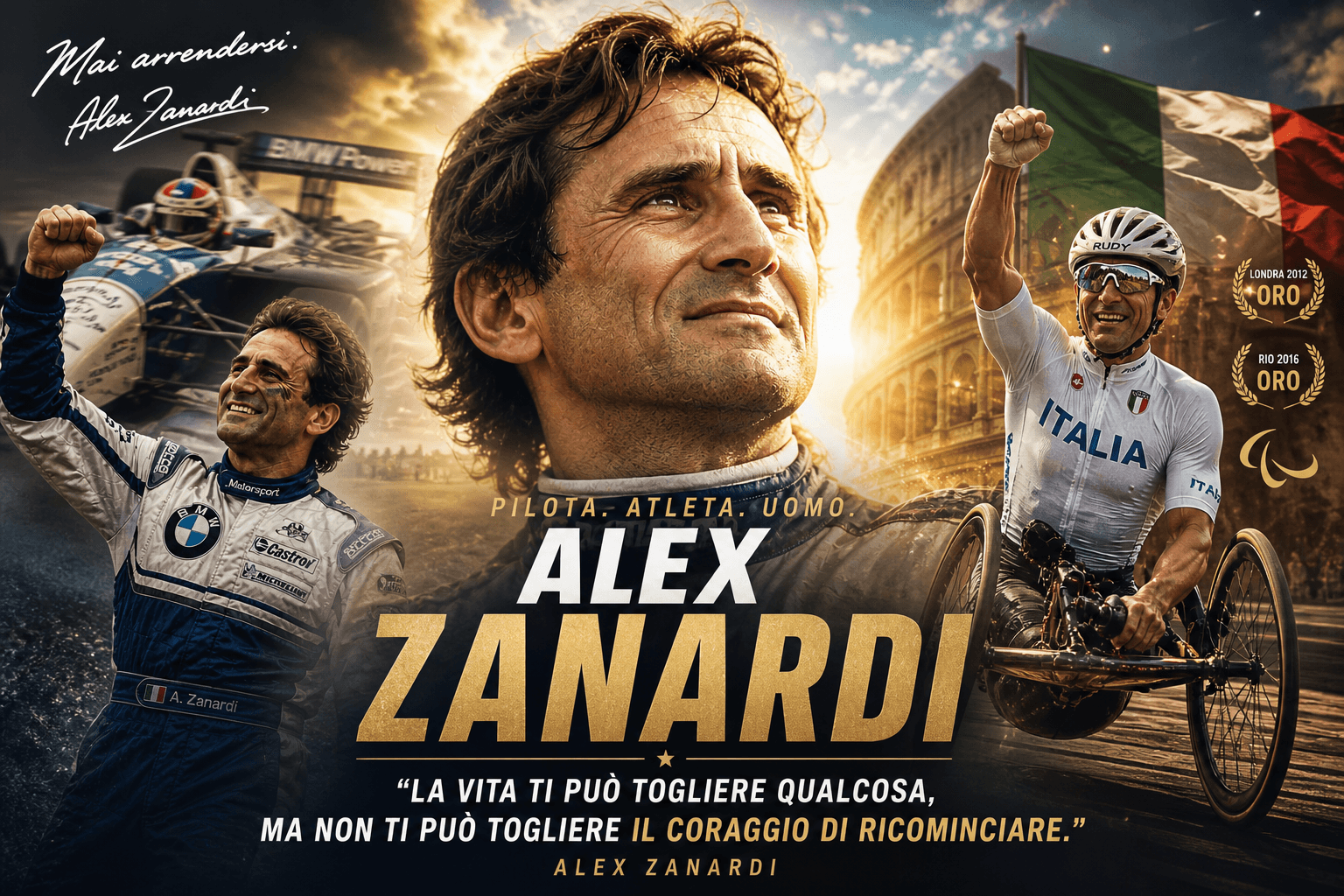
In the United States he finds what had been missing for him in Europe: confidence, space, opportunity. In CART, between 1996 and 1999, he becomes one of the most spectacular drivers in the category. He wins two championships (1997 and 1998) and wins over the crowd with an aggressive and unpredictable style.
The overtake on Bryan Herta at Laguna Seca, the famous “The Pass”, remains one of the most iconic moves in motorsport history. It is not just technique: it is pure courage, vision, instinct.
In those years, colleagues and rivals begin to describe him as one of the most complete drivers. Some portray him as “impossible to read”, capable of changing pace and strategy without warning. Zanardi has finally arrived.
The day that changed everything: Lausitzring 2001
15 September 2001 is a date that interrupts the narrative. During a race at Lausitzring, in Germany, Zanardi loses control of the car and is violently hit by another car.
The images are dramatic. The conditions are desperate. The doctors fight to save his life. The amputation of both legs is inevitable.
At that moment, the world of motorsport stops. Drivers, teams, fans: everyone understands that this is not just an accident, but a deep fracture.
In the following years, many Formula 1 protagonists have remembered that day as one of the hardest they ever lived through. Some have admitted that Zanardi’s reaction, even more than the crash, changed the way they see sport.
The rebirth: learning to live again, before even racing again
The return is not immediate. It is made up of hospitals, rehabilitation, pain. But also of astonishing clarity. Zanardi does not let himself be defined by what he has lost.
One of his phrases is famous, often remembered by other athletes too: life changes, but it can still remain full. It is not rhetoric, it is a concrete way of facing reality.
In 2003 he returns to driving, symbolically completing the missing laps of the Lausitzring race. It is a powerful moment, not only a sporting one. It is a declaration: the story does not end there.
The return to racing and the new challenge
Zanardi goes back to competing in the European Touring Car Championship with BMW. The cars are adapted, the controls modified. But the substance remains: he is still a driver.
He wins races, takes podium finishes, and proves that the talent has remained intact. Rivals do not treat him as a symbol, but as a real competitor. And perhaps that is the most important recognition.
The handbike and Paralympic consecration
When he switches to handbike, many think it is a final stage. In reality it is a new beginning. The effort is different, quieter, less spectacular. But the competition is fierce.
At the London 2012 Paralympics he wins two golds and one silver. At Rio 2016 he adds two more golds. Dominant performances, built on gruelling training and absolute discipline.
Athletes and technicians point out how his presence has raised the level of Paralympic sport, bringing global attention and changing public perception.
The new accident and the silent struggle
In 2020, during a charity relay, a new accident leaves him in critical condition. Once again, his life hangs by a thread.
The sporting world responds with an outpouring of support. Drivers, champions, teams: the message is unanimous. Zanardi is more than an athlete.
The most recent comments from the paddock speak of a respect that goes beyond results. Some drivers openly talk about how his story has influenced their mental approach, their ability to handle pressure and failure.
The legacy: a lesson without rhetoric
Telling Zanardi’s story means coming to terms with something that goes beyond sport. It is not just a story of victories or crashes. It is a story of continuity.
He never presented himself as a hero. He never tried to be one. He simply kept doing what he knew how to do: live, compete, adapt.
In an era in which success is often measured in numbers, Zanardi represents another metric. That of presence, of the ability to remain within difficulties without being overwhelmed by them.
A trajectory that does not end
His story does not have a clear ending. It cannot have one. Every time it seems to reach a final point, a new direction emerges.
Alex Zanardi remains a unique figure in contemporary sport. Not only for what he has done, but for the way he has done it. With disarming naturalness, with a strength that does not need to be declared.
And perhaps that is precisely his greatest legacy: proving that even after the most violent impact, there is always a chance to start again. Not the same as before, but authentic. Always.