A simple rule, a universal lesson
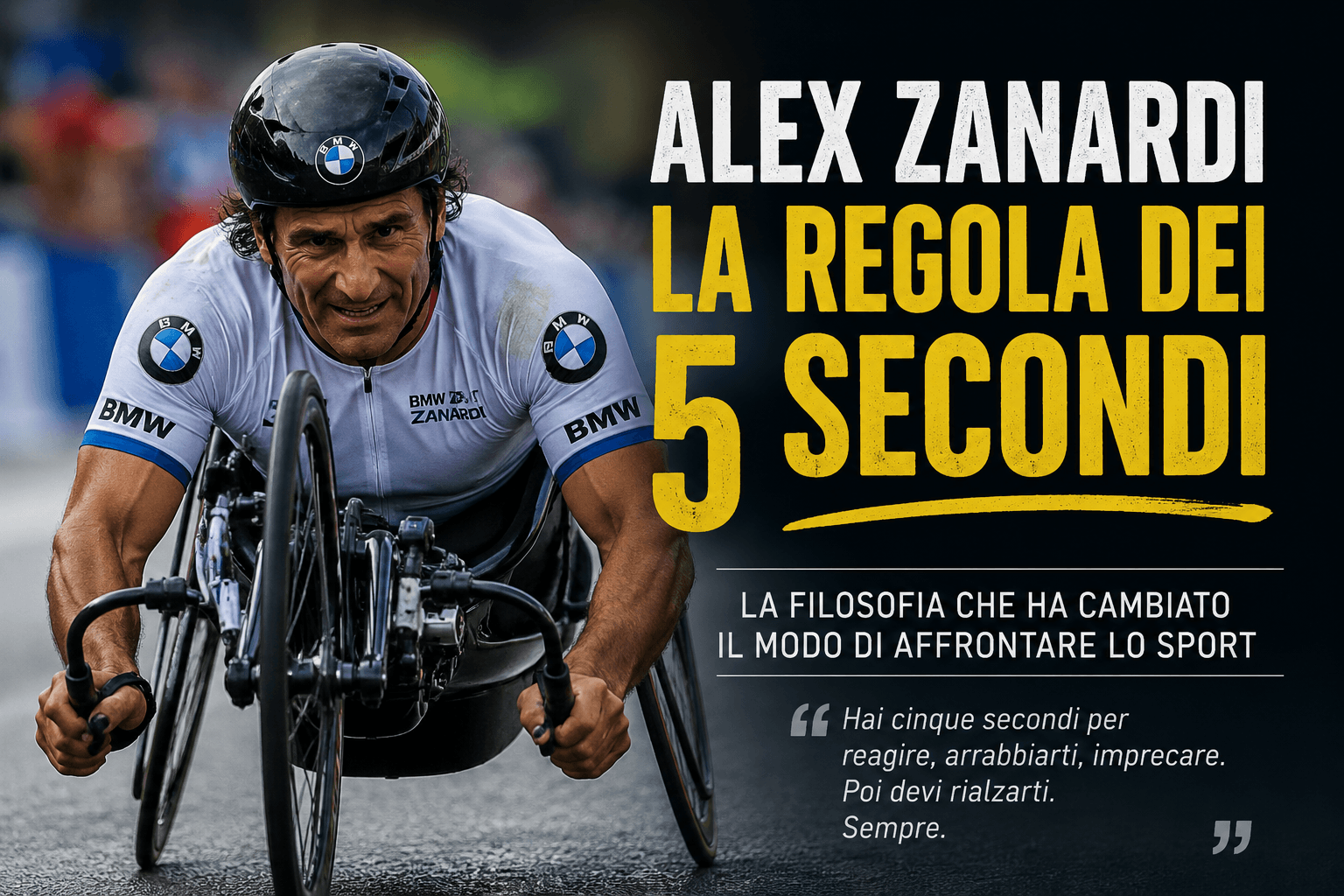
In the international sporting landscape, few stories have had such a profound impact as that of Alex Zanardi. Not only for the results achieved in Formula 1, CART and the Paralympics, but for a vision of life that has become part of the collective heritage: the so-called “5-second rule”.
Zanardi has told it several times over the years, including in recent public appearances fed into the contemporary sporting debate. The principle is simple: when something negative happens, you have five seconds to react emotionally. After that, you have to move on. It is not a denial of pain, but a mental discipline that requires you not to remain a prisoner of it.
This philosophy, now also cited by athletes of a new generation, continues to emerge in sporting narratives as one of the most effective models of resilience applied to competition.
From the crash to rebirth: the context that created the myth
To truly understand the significance of the 5-second rule, it is necessary to go back to 2001, to the dramatic crash at the Lausitzring circuit in Germany. Zanardi lost both legs, but not the ability to imagine a future.
In the years that followed, his return to sport through handbike racing and his extraordinary Paralympic victories turned that rule into something concrete. Not motivational theory, but daily practice.
In the paddock and at modern circuits, his name is often invoked when talking about mental strength. Drivers from different categories, from Formula 1 to endurance competitions, have recently underlined how the management of mistakes and difficulties is now as central as technical preparation. In this sense, Zanardi’s lesson has become an implicit reference point.
The 5-second rule in modern sport
Pressure, error and restarting
Contemporary sport lives on tiny margins. A mistake can compromise an entire race, a season, sometimes a career. In this context, the ability to react quickly has become a decisive skill.
Several drivers, in more recent interviews, have highlighted how mental management is now an integral part of performance. The concept of “resetting” immediately after a mistake is increasingly widespread, and directly echoes the principle expressed by Zanardi.
It is no longer just about talent or speed, but about clarity of thought. The difference between a champion and a good driver, today, often comes down to the ability not to remain stuck in the negative moment.
The cultural influence in the paddock
Although not always explicitly mentioned, the Zanardi model has entered sporting culture. Some drivers talk about “accepting the mistake and moving on”, others about “not wasting mental energy”. They are modern variations of a philosophy with deep roots.
Outside motorsport too, Olympic and Paralympic athletes continue to recall the value of immediate resilience. The speed with which disappointment is turned into fresh competitive energy is now considered one of the keys to success.
A philosophy that goes beyond the result
Beyond victory and defeat
The strength of the 5-second rule lies in its universality. It does not promise victories, but it offers a tool for dealing with any outcome. In an era in which the result seems to define everything, Zanardi has turned the perspective upside down: what matters is the response, not the event.
This approach has also been taken up in recent analyses of the sporting world, where it is shown that the mental growth of athletes is increasingly decisive. Resilience is no longer an accessory value, but a structural element of performance.
Alex Zanardi’s legacy
Zanardi’s contribution to sport goes beyond medals and trophies. His ability to turn a tragic event into a new life path continues to inspire generations.
The 5-second rule remains one of the most powerful symbols of this legacy. A perfect synthesis of personal experience and universal application, capable of crossing disciplines, eras and contexts.
In contemporary sporting storytelling, dominated by technology and data, Zanardi’s lesson reminds us that there is still a fundamental space for the human dimension. And it is precisely there, in those five seconds, that everything is often decided.