Twenty-four drivers. All in the same car.
An almost cruel experiment in its purity.
No technical differences, no hidden advantages. Only talent, sensitivity, instinct. The perfect context to understand who was really faster.
And this is where the story changes direction.
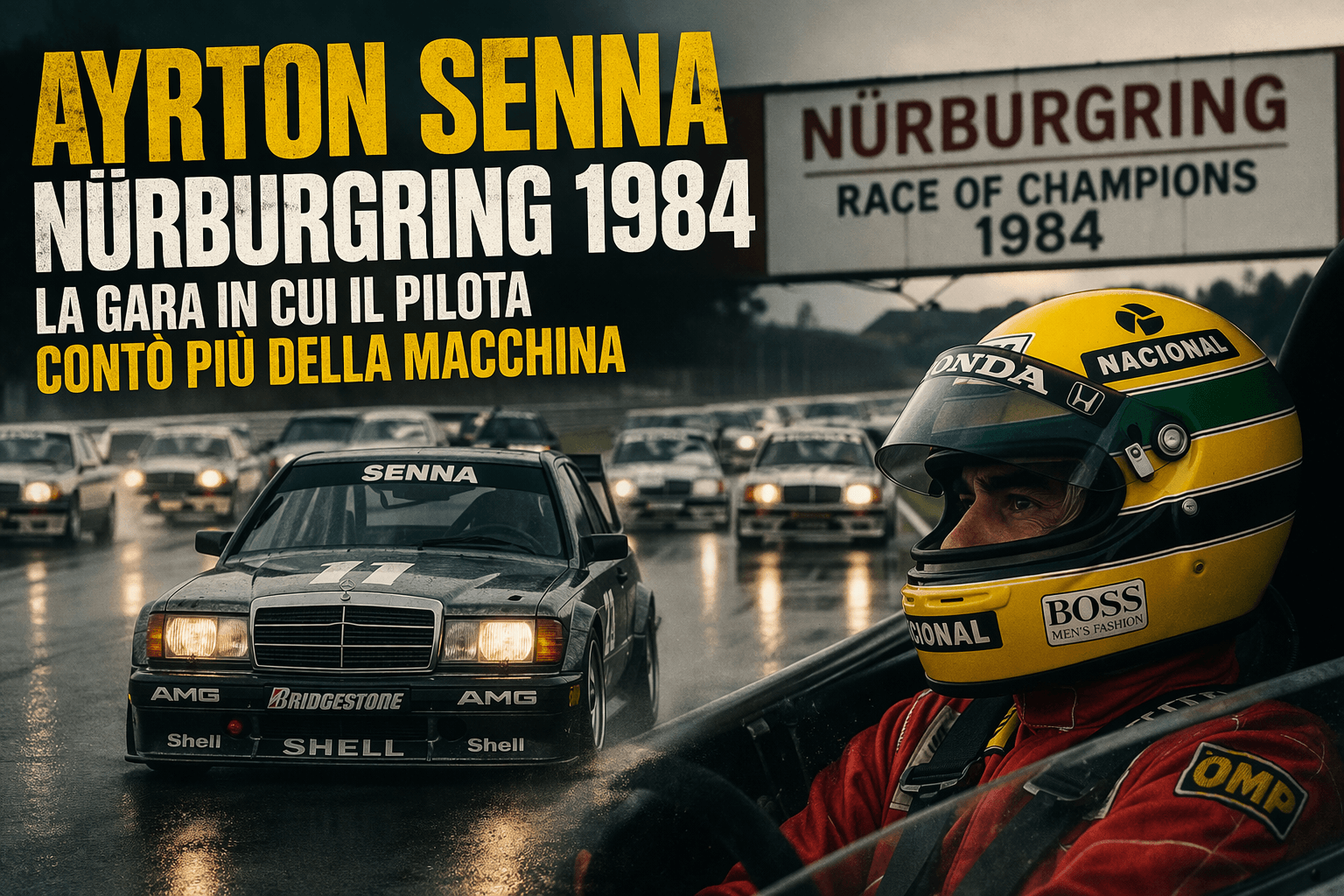
Race of Champions 1984: everyone in the same car, no alibis
The silent protagonist was the Mercedes-Benz 190E 2.3-16, chosen by Mercedes-Benz.
A saloon car. Not a Formula 1 car.
Heavy, less responsive, less extreme. A car that does not forgive. That does not amplify talent, but lays it bare.
The Mercedes 190E: when the machine stops making the difference
This is where the heart of the race comes: driver versus machine.
Because when the vehicle is identical, you cannot hide. You cannot delegate to technology. You have to find speed within yourself.
Some drive.
Others adapt.
Only one interprets.
Senna against the champions: Lauda, Prost, Hunt
There were no supporting acts on track.
Niki Lauda, icy and precise.
Alain Prost, methodical, perfect.
James Hunt, instinctive and irregular talent.
And then there was him.
Ayrton Senna.
Young. Almost out of place. But already different.
Experience versus instinct
The others know speed.
Senna feels it.
The others manage the car.
He listens to it.
And in that subtle difference, a gap opens up.
How Senna drove: the invisible difference
At the start he watches.
He understands the car's weight, the weight transfer, the limits. He does not force it. He does not go for the time straight away.
Then he changes pace.
He brakes later.
He turns in with more commitment.
He exits better.
He does not seem faster.
He is.
The difference is not spectacular. It is inevitable.
Where others control, he flows.
Where others react, he anticipates.
This is where the key concept is born: the driver's pure talent.
The finale: when talent beats the machine
In the decisive phases, everything is compressed.
Reduced space. Reduced time. Zero margin.
And it is precisely there that the driver emerges.
Senna sees first.
He decides first.
He gets through first.
He never really forces it. But he is always one step ahead.
He takes the lead and never gives it up.
He crosses the line ahead of everyone.
Ahead of the champions.
Ahead of experience.
Ahead of logic.
Why Nürburgring 1984 is the symbolic Formula 1 race
Nürburgring 1984 remains a unique race because it removes every variable.
And when you remove everything, truth remains.
The car does not win.
The strategy does not win.
The context does not win.
The driver wins.
The day the legend was born
That day Ayrton Senna did not just win a race.
He proved something.
That speed is a form of sensitivity.
That talent is vision.
That between man and machine there is a relationship that cannot be taught.
And that, when everything is the same, those who are not the same emerge.
Conclusion
If you take away the car, the driver remains.
And that day, at the Nürburgring,
Ayrton Senna
was simply better than everyone else.