Bike market ·
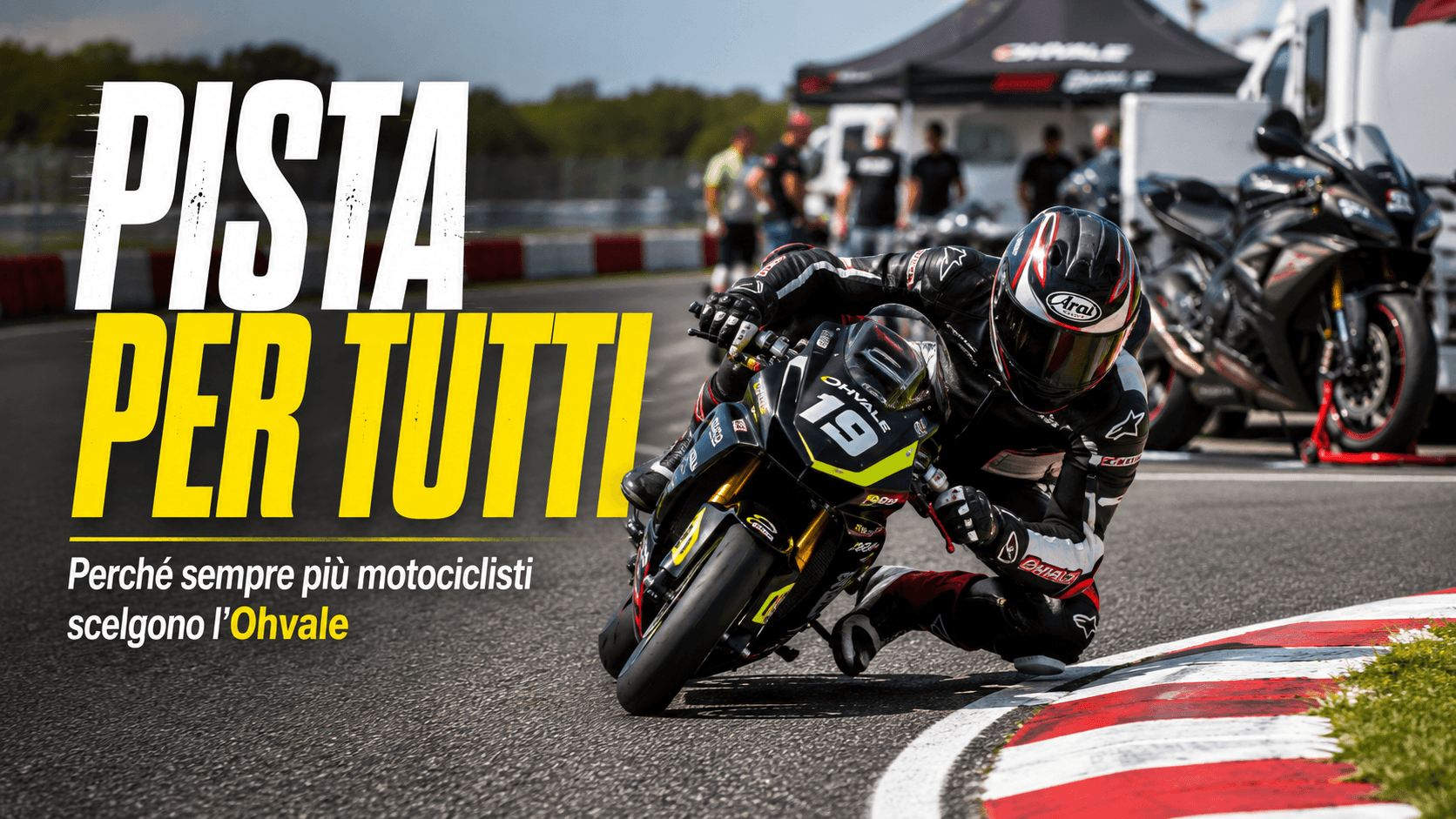
Ohvale: the smartest way to ride on track without spending a fortune
A day on track can cost hundreds of euros. With an Ohvale you can train more often, spend less and improve your riding.
Motorsport Magazine
Bike market ·
Find out the differences between a V4 engine and an inline four-cylinder in racing motorcycles: performance, handling, advantages and which is really better.
Ultimogiro Newsroom · 22 April 2026 · 5 min read
In modern motorcycling, talking about performance inevitably means talking about compromises. Every technical choice is the result of a balance between power, control, aerodynamics and tyre management. At the centre of this balance is the engine, the element that more than any other defines a bike's character.
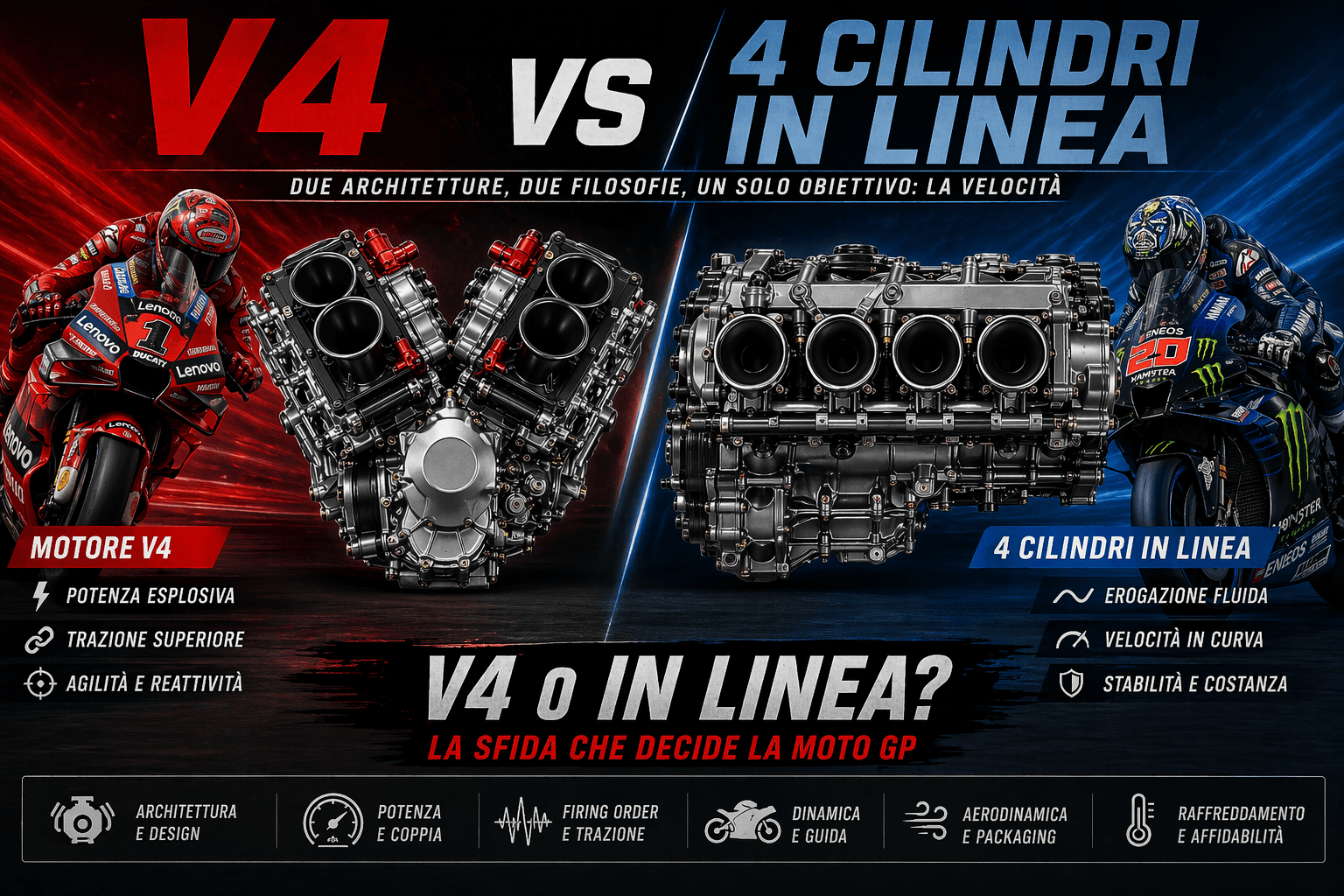
In recent years, the comparison has focused on two very specific architectures: the V4 engine and the inline four-cylinder. These are not simply two different construction solutions, but two design philosophies that profoundly influence the bike's behaviour on track.
The V4 engine stems from a typically racing requirement: to achieve maximum performance in the most compact space possible. The four cylinders are arranged on two inclined banks, generally between 65 and 90 degrees, a solution that makes it possible to shorten the engine and concentrate the masses towards the centre of the bike.
This compactness is not just a theoretical advantage. It allows designers to work better on aerodynamics, to adopt longer swingarms and to optimise weight distribution. In other words, it offers more freedom in the overall design of the bike.
The inline four-cylinder, on the other hand, follows a different logic. The cylinders are arranged in a single transverse row, in a simpler and more linear configuration. This solution has historically been appreciated for its reliability, ease of management and more predictable behaviour. It is an engine that does not seek extremity, but balance.
The most obvious difference between a V4 and an inline four-cylinder emerges not so much in the absolute numbers, but in the way the power is delivered.
The V4 stands out for its more decisive character. Torque is often stronger in the mid-range and throttle response is more direct. This translates into very effective acceleration, especially on corner exit, where the ability to put power down quickly makes the difference to lap time.
The inline four-cylinder, by contrast, favours progressiveness. The delivery is more linear, less abrupt, and this allows the rider to manage grip better, especially in the more delicate phases of riding. The bike feels more “rounded”, less nervous, and allows high cornering speeds to be maintained through the bend.
This difference in character is one of the main reasons why Ducati and Yamaha, today, represent two opposite but equally fascinating approaches to MotoGP.
A less visible but fundamental aspect is the firing order of the cylinders, the so-called firing order. This is where much of a bike's ability to find traction is decided.
In the V4, designers exploit irregular firing sequences, such as the so-called “big-bang”. The combustion events occur in rapid succession, followed by a pause. This pause allows the rear tyre to recover grip, improving the ability to put power down.
In the traditional inline four-cylinder, instead, the combustion events are regular and evenly spaced. The result is a continuous and predictable delivery. Yamaha introduced an important variation with the crossplane crankshaft, which breaks this regularity and brings the engine's behaviour closer to that of a V4, while still retaining some characteristics typical of the inline architecture.
The length of the crankshaft directly affects the gyroscopic effect, that is, the resistance the engine opposes to changes of direction.
In the V4, the crankshaft is shorter and this reduces rotational inertia. The bike is more agile, quicker in changes of direction and more responsive in flowing sections.
In the inline four-cylinder, the longer crankshaft generates a greater gyroscopic effect. This makes the bike more stable at high speeds and more precise on wide lines, but slightly less quick in changes of direction.
It is, once again, a choice: agility against stability.
In contemporary MotoGP, aerodynamics have taken on a central role. Fairings, wings and airflow management have become elements as decisive as the engine itself.
From this point of view, the V4 offers an important structural advantage. Being narrower at the front, it allows better aerodynamic penetration and more efficient airflow management.
The inline four-cylinder, being wider, makes the designers' job more complex. It is not an insurmountable limit, but in a context where every detail counts, it represents a concrete disadvantage.
If the V4 excels in terms of performance and compactness, it does pay a price in terms of complexity.
The presence of two banks makes cooling more difficult, especially for the rear cylinders. In addition, the structure is more complex, with a greater number of components and more sophisticated design.
The inline four-cylinder, instead, offers simpler thermal management and more immediate maintenance. All the cylinders are exposed at the front and the system is generally more accessible and less expensive to run.
All these technical differences inevitably are reflected in riding style.
Bikes with a V4 engine tend to favour aggressive riding: hard braking, decisive corner entry and violent acceleration on corner exit. It is a style built around “stop and go”, where the aim is to exploit the available power to the fullest.
Bikes with an inline four-cylinder, instead, reward smoother riding. The lines are cleaner, corner speed is higher and throttle control is more progressive. It is a less spectacular but extremely effective style.
The question, at this point, is inevitable. Is there really a better engine?
The answer is more complex than it may seem. The V4, today, represents the most complete solution in MotoGP, thanks to its ability to combine power, compactness and aerodynamic advantages. It is no coincidence that most manufacturers have chosen this architecture.
However, the inline four-cylinder continues to prove highly effective, especially when the bike's overall package is well balanced. Its fluidity and ease of management remain fundamental qualities, especially in difficult conditions or on particularly technical tracks.
The comparison between the V4 and the inline four-cylinder cannot be reduced to a simple ranking. These are two different ways of interpreting performance.
The V4 represents the search for maximum effectiveness, for power exploited without compromise, for technology taken to the limit.
The inline four-cylinder, instead, embodies balance, precision and the ability to make the bike more readable for the rider.
In modern motorcycling, the V4 has gained a clear advantage. But the inline four still reminds us that, on track, the difference is made not only by the power available, but by how much of that power can actually be used.
And it is precisely in this balance that true speed is still decided today.
Next story
Bike market ·
A day on track can cost hundreds of euros. With an Ohvale you can train more often, spend less and improve your riding.

Bike market ·
Bike market ·

Bike market ·
Bike market ·

Bike market ·
Bike market ·