MotoGP ·
MotoGP Qatar, Bezzecchi takes record pole at Lusail ahead of Márquez
At Lusail Bezzecchi takes pole in 1:50.028 and the track record. Márquez is second, Di Giannantonio completes the front row.
Motorsport Magazine
MotoGP ·
Discover the evolution of MotoGP from 500 two-strokes to advanced four-strokes. A journey through racing history.
Ultimogiro Newsroom · 13 May 2026 · 3 min read
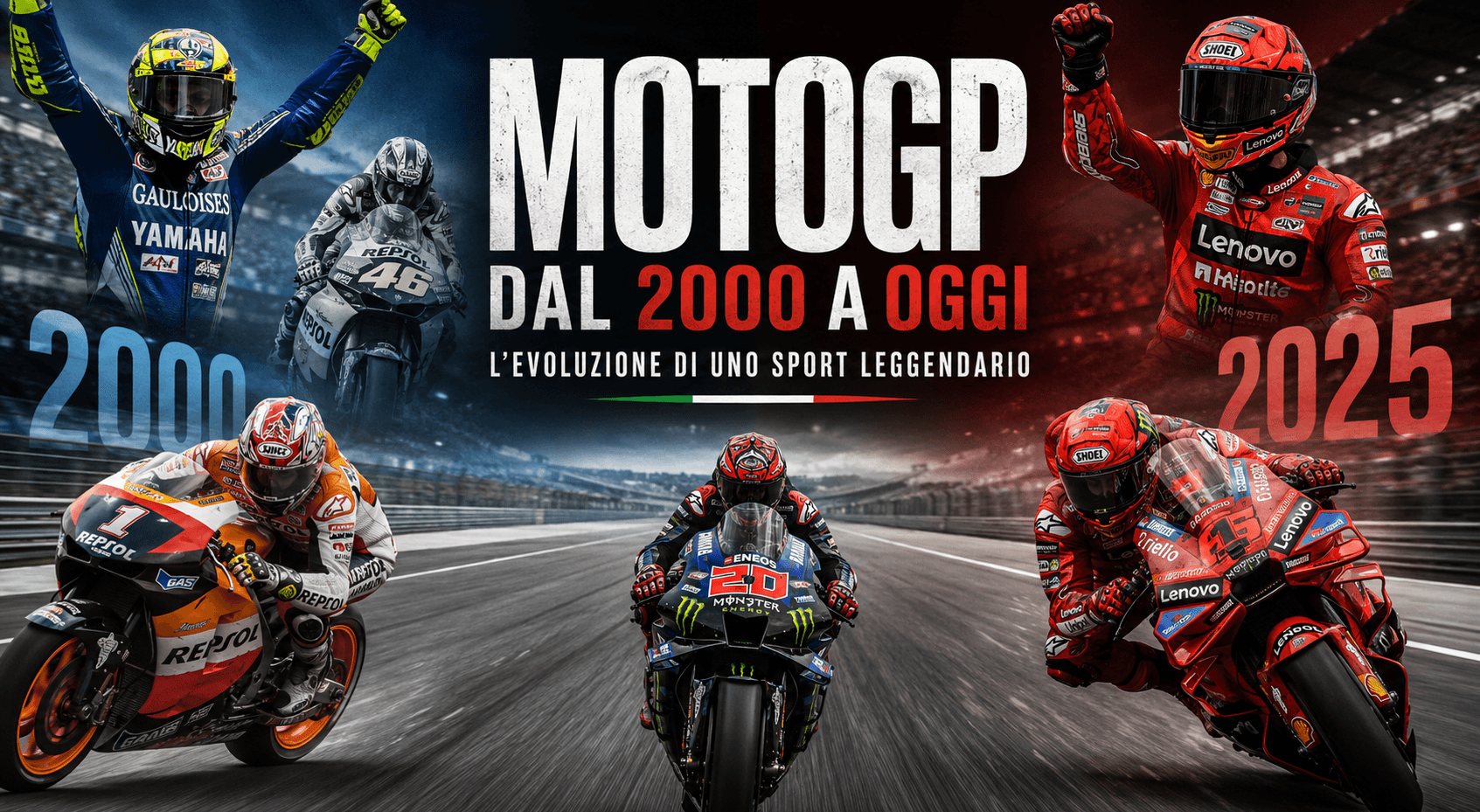
At the start of the 2000s, motorcycle racing still had the rough, spectacular face of 500 two-strokes. Light, nervous bikes that were extremely difficult to control, capable of putting even the most experienced riders in trouble. It was an era in which pure talent and courage seemed to matter more than anything else.
Then 2002 arrived and everything changed.
The official birth of MotoGP marked the move to the new 990cc four-stroke bikes, much more powerful and technologically advanced. It was a huge revolution. It was not only the bikes that changed, but the whole approach to racing: electronics began to play a central role, manufacturers' investment increased and work in the pits became increasingly sophisticated.
As the years passed, MotoGP has turned into a true technological laboratory. First came the switch to 800cc engines in 2007, then the return to 1000cc in 2012. In the meantime, increasingly complex systems arrived: traction control, anti-wheelie, inertial platforms and aerodynamic devices that radically changed the behaviour of the bikes.
Today a MotoGP bike is a concentration of extreme technology. Every detail is analysed through data, simulations and telemetry. Modern bikes comfortably exceed 360 km/h and demand absolute precision from both riders and engineers.
Over the last twenty-five years there have been moments that have changed motorcycle racing history forever.
One of the most important is certainly 2004, when Valentino Rossi left Honda to join Yamaha. Many considered that choice a mistake, but Rossi immediately managed to win the world championship, turning that season into one of the most iconic feats of modern MotoGP.
In 2007 came Casey Stoner's title with Ducati, the first MotoGP world championship for the Italian manufacturer. It was a historic success that showed how even a European manufacturer could break Japanese dominance.
Another decisive moment was Marc Márquez's debut in 2013. Márquez won the title in his first year in MotoGP, showing a completely new riding style and redefining the very concept of aggression on track.
The 2015 season, with the tension between Rossi and Márquez, still remains one of the most discussed and controversial in World Championship history. In recent years, meanwhile, the introduction of Sprint Races in 2023 has further changed the race weekend, increasing the spectacle and the pressure on the riders.
Modern MotoGP has been transformed not only by technology, but above all by the riders who have defined its different eras.
Valentino Rossi had an impact that went beyond sporting results. He turned MotoGP into a global phenomenon, attracting millions of new fans and making motorcycle racing much more popular even outside the racing world. His rivalries, his charisma and his ability to communicate changed the face of the championship.
Then came Casey Stoner, considered by many to be one of the purest talents ever seen. His ability to control extremely difficult bikes seemed almost natural, especially under acceleration and in managing the rear end.
Alongside him, Jorge Lorenzo represented the opposite: absolute precision, perfect lines and an impeccably clean riding style. With Lorenzo, MotoGP began to reward consistency and technical perfection even more.
Finally, Marc Márquez completely revolutionised the physical approach to riding. Extreme braking, aggressive corner entries and impossible saves hugely raised the athletic level required of modern riders.
Today a new generation made up of riders such as Francesco Bagnaia, Fabio Quartararo, Jorge Martín and Pedro Acosta is carrying this evolution forward, in an increasingly professional and technological environment.
The future of MotoGP will be marked by a very delicate challenge: continuing to innovate without losing the spectacular soul of motorcycle racing.
In the coming years the category will focus increasingly on sustainability, with regulations designed to reduce emissions, costs and excessive speeds. From 2027 new technical rules and more sustainable fuels will arrive, while aerodynamics could be limited to improve the spectacle on track.
MotoGP will probably continue to become ever more technological, but the real balance will be keeping the rider's role central. Because, despite electronics, data and simulations, what continues to make this sport unique is still the human factor.
Risk-taking, courage and riders' ability to push beyond every limit remain the authentic heart of MotoGP. And it is precisely this ongoing challenge between man and machine that, from 2000 to today, has made motorcycle racing one of the most fascinating spectacles in world motorsport.
Next story
MotoGP ·
At Lusail Bezzecchi takes pole in 1:50.028 and the track record. Márquez is second, Di Giannantonio completes the front row.
Standings
2026 season · After round 19 of 22 · Updated 7 Nov · Source: MotoGP.com
Full standings2026 season · After round 19 of 22 · Updated 6 Nov · Source: MotoGP.com
Full standings2026 season · After round 19 of 22 · Updated 1 Nov · Source: MotoGP.com
Full standingsNext race
MotoGP
Lusail International Circuit
Race starts in
MotoGP ·
MotoGP ·
MotoGP ·
MotoGP ·
MotoGP ·
MotoGP ·