Monza, a shock start changes the face of the race
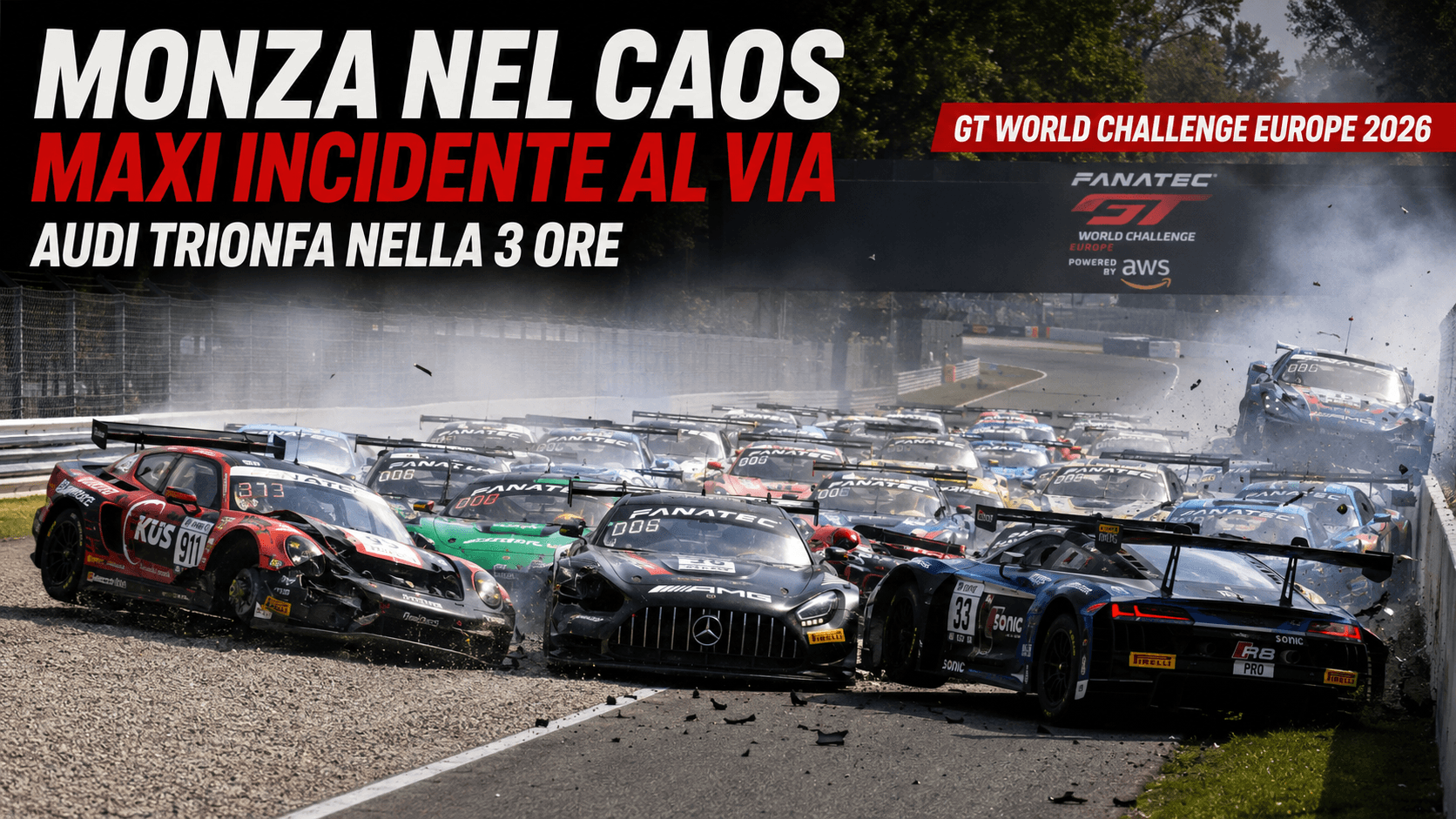
The GT World Challenge Europe Endurance Cup delivered one of the most intense and controversial spectacles of recent years at Monza. The 3 Hours held on the historic Brianza track was marked by a huge crash at the start involving numerous cars and affecting the entire course of the race, leaving room for controversy and debate in the paddock.
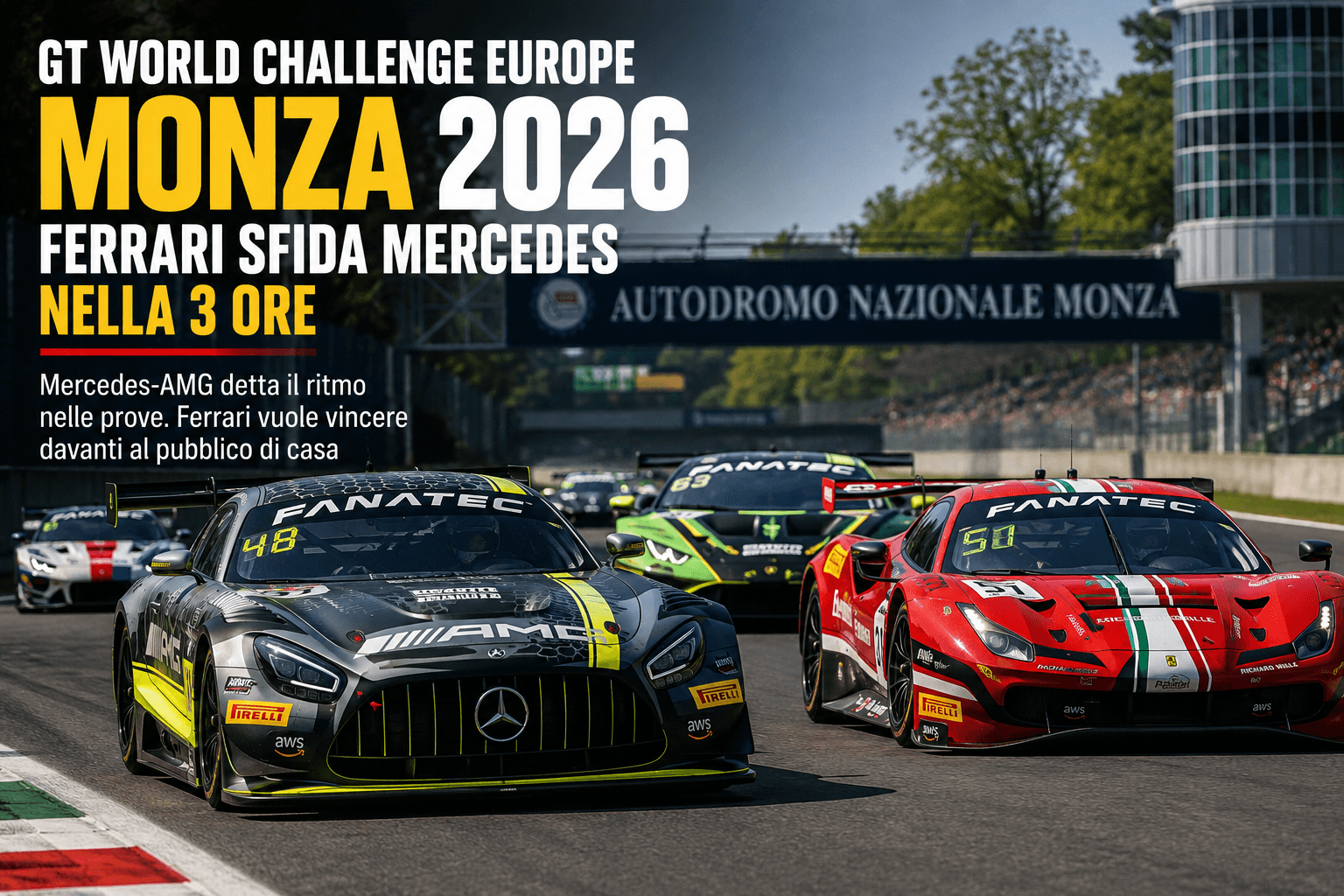
Expectations for the race were sky-high. More than fifty GT3 cars lined up on the starting grid of the Temple of Speed, ready to fight for a crucial victory in the title battle. But just a few seconds after the lights went out, that was enough to turn one of the season’s most anticipated races into a real survival battle.
Into the braking zone of the Prima Variante, the pack arrived tightly bunched, with cars side by side in several rows. In the middle of the traffic, a critical situation was created that triggered a chain of contacts. In a few moments the track was covered in debris, damaged cars and cars forced into retirement before even completing the first lap.
The intervention of the Safety Car became inevitable while marshals and teams worked to clear the track and allow the race to restart.
Huge damage and a compromised race for many protagonists
The tally from the crash is very heavy. Several cars sustain irreparable damage and immediately see any chance of a result disappear. Others manage to return to the pits but lose time that definitively compromises their race.
For many teams, the trip to Monza ends with a hefty bill to pay in repairs and rebuilding the cars ahead of the next rounds of the championship. Fortunately, all the drivers involved got out of their cars without any significant physical consequences.
Controversy in the paddock after the huge crash
As often happens in incidents of this scale, the aftermath was marked by numerous discussions. Some drivers pointed out that the combination of the width of the main straight and the narrowing of the Prima Variante makes Monza one of the most delicate circuits on the entire GT calendar.
Much of the attention centred on Maxime Martin. The Belgian driver was identified by several observers as one of the protagonists of the sequence that led to the initial pile-up. Martin, however, rejected the accusations, claiming that he had not caused any direct contact and that he had been caught up in a situation that developed in a fraction of a second.
The television images and subsequent analyses continued to fuel the debate, once again showing how difficult it is to assign precise responsibility in crashes involving so many cars in such a confined space.
The Prima Variante comes under scrutiny again
The incident inevitably brings attention back to the safety of Monza’s Prima Variante. Over the years, the circuit’s most iconic corner has been the scene of numerous incidents in touring car, GT and single-seater categories.
The arrival of more than fifty cars at speeds above 250 km/h into such a tight braking zone represents one of the toughest challenges in modern motorsport. The spectacle of the start is undeniable, but the events of this edition once again show how tiny the margin for error is.
Perfect Audi: victory rewards strategy and cool heads
Amid the general chaos, the flawless performance of the Audi number 66 entered by Tresor Attempto Racing stands out. After avoiding the problems at the start, the crew made up of Rocco Mazzola, Sebastian Øgaard and Ariel Levi built their success through perfect race management.
The Italian team made the most of the early neutralisations, kept a consistent pace throughout the stints and made very few mistakes in the decisive phases of the race. A performance built with patience and precision that allows Audi to claim a highly prestigious victory ahead of extremely fierce competition.
In a category where gaps are often measured in just a few seconds after three hours of racing, the ability to maintain concentration and consistency proves decisive.
Ferrari, Porsche, BMW and Mercedes star in the battle
Behind the winners, there was no shortage of duels that shaped the middle and final stages of the race. Ferrari, Porsche, BMW, Mercedes-AMG and Aston Martin put on a close fight for the top positions, confirming the very high competitive level of the GT World Challenge Europe.
The variety of constructors present in the leading positions is one of the strengths of the series organised by SRO, capable of delivering closely fought and unpredictable races right down to the final pit stop.
Monza confirms the appeal of the GT World Challenge Europe
The Italian round of the GT World Challenge Europe Endurance Cup leaves behind images destined to remain in the minds of fans. On the one hand, the huge crash on the first lap, already among the most spectacular and discussed incidents of recent years. On the other, a race that rewarded preparation, strategy and the ability to stay composed in the most complex situations.
The success of the Audi number 66 relaunches the team’s ambitions in the title fight and confirms the worth of a squad capable of taking every opportunity. For the rivals, meanwhile, Monza is a lesson to be filed away quickly ahead of the next rounds of a season that still looks set to be long and hard-fought.
The GT World Challenge Europe thus bids farewell to the Temple of Speed after a weekend full of emotion, spectacle and twists, with its eyes already on the next Endurance Cup challenges.