Jorge Lorenzo never changes his spots: the ghost of 2015 returns to divide MotoGP
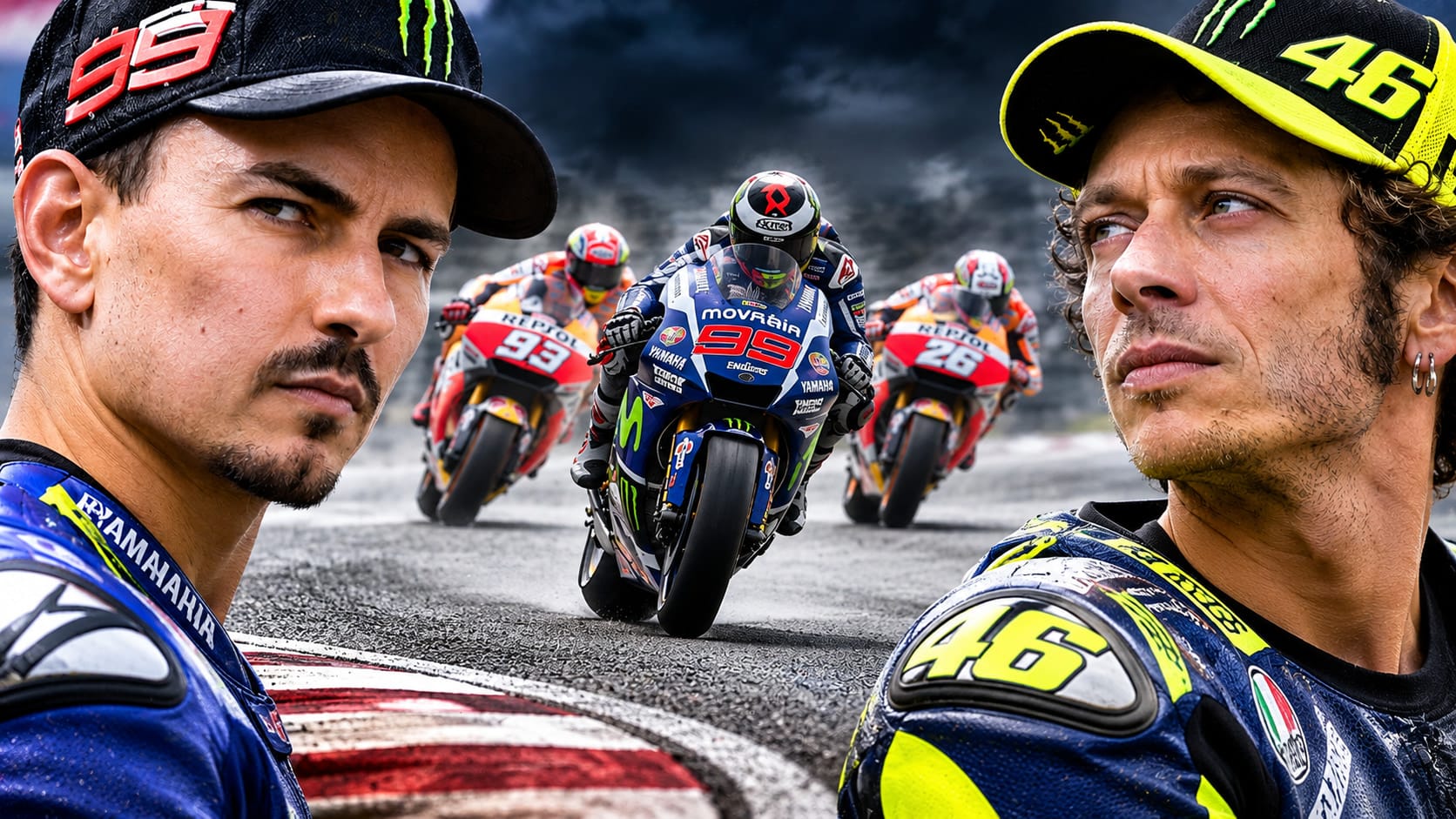
A phrase attributed to the Majorcan about Valentino Rossi sparks the controversy. Lorenzo denies it, but his history with the Doctor is full of cutting remarks, controversial gestures and second thoughts. From the thumbs-down in Sepang to the Valencia world championship, all the way to the words on the alleged help from the Hondas: why 2015 continues to weigh so heavily.
Lorenzo, Márquez and that phrase about Rossi that reignited everything
There are riders who, once they hang up their helmet, manage to leave even the fiercest rivalries behind them. Others, instead, seem destined to find them waiting every time a microphone is switched on.
Jorge Lorenzo belongs, at least in his public story, to the second category.
The five-time world champion has returned to the centre of the debate after comments made to TNT Sports during the Qatar Grand Prix. The subject is the one that has divided fans for decades: who is the greatest rider in history?
Lorenzo named Marc Márquez as the leading candidate of the modern era, virtually comparing him with Giacomo Agostini. A legitimate, sustainable position that is perfectly understandable in light of the Spaniard's talent.
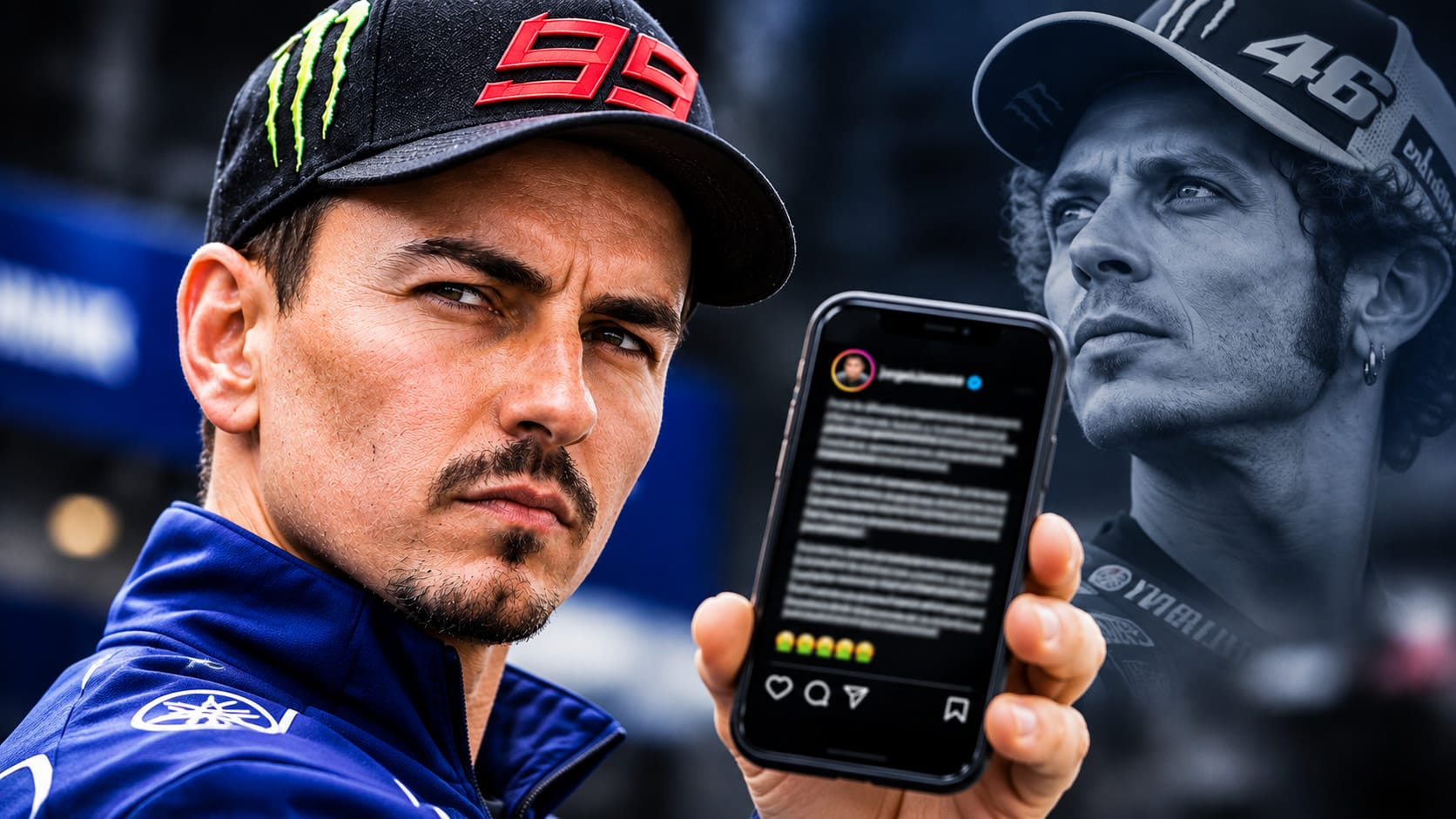
The controversy erupted when some outlets attributed to the Majorcan a phrase that explicitly excluded Valentino Rossi from that comparison.
Lorenzo reacted strongly, denying that he had spoken those words and accusing the media of journalistic manipulation.
A necessary clarification: from the available reconstructions, his favourable judgement on Márquez emerges, but not an independent confirmation of the phrase against Rossi. The denial, therefore, must be taken seriously.
And yet, beyond this specific affair, one question remains.
Why is it that every time Lorenzo, Rossi and Márquez end up in the same discussion, it seems as though we are suddenly back in 2015?
The answer is not hidden in a single interview. It is scattered across years of rivalry, statements and contradictions.
Sepang 2015: when Lorenzo asked for a harsher punishment for Rossi
25 October 2015. Malaysian Grand Prix.
Valentino Rossi and Marc Márquez are the protagonists of one of the most controversial episodes in recent motorcycle history. After a long series of overtakes and counter-overtakes, at turn 14 the two make contact and Márquez ends up on the ground.
Race Direction penalises Rossi with three penalty points on his licence. Adding the points already received earlier, the rider from Pesaro reaches the threshold that carries a start from the last position in the next race.
That race is Valencia. The last of the world championship.
The decision is official. The interpretations of the protagonists' intentions, however, continue to divide opinion.
At that moment Lorenzo is not a neutral observer. He is Rossi's direct rival in the title fight.
Yet he publicly steps in to argue that the sanction imposed on his team-mate is too light. He goes so far as to suggest a heavier penalty, such as a ride-through or a black flag.
The point is not to deny Lorenzo the right to speak. The point is the context.
A rider involved in the same World Championship fight who calls for a harsher punishment for his direct rival can hardly expect those words to be received as a simple technical comment.
This is where one of the most obvious contradictions in his career begins: Lorenzo claims the right to honesty, but sometimes seems to underestimate the weight his own words take on when they coincide with a personal sporting interest.
The thumbs-down: the gesture Lorenzo himself defined as unsporting
In Sepang there were not only statements.
During the podium ceremony, while Rossi was receiving the trophy for third place, Lorenzo was caught on camera giving the thumbs-down to his team-mate.
A blatant gesture, inevitably destined to fuel further tension.
A few days later, in Valencia, the apologies arrived.
Lorenzo acknowledged that he had been wrong and described that behaviour as unsporting.
An important admission, which also shows the Majorcan's ability to recognise a mistake.
But the meaning of that image remains: two riders from the same team, locked in a full title fight, already divided by a rivalry that had gone beyond the boundaries of the track.
The wall that years earlier had separated their Yamaha pits seemed to be back. Not physically, but in their relationship.
Valencia 2015: five points and a wound that never healed
8 November 2015.
Jorge Lorenzo wins the Valencian Community Grand Prix. Marc Márquez finishes second, Dani Pedrosa third. Valentino Rossi, starting from the back of the grid, comes through to finish fourth.
The final standings of the championship are merciless in their simplicity:
Jorge Lorenzo: 330 points.
Valentino Rossi: 325 points.
Five points. That is the margin by which Rossi loses his tenth world title.
A World Championship remembered collectively not only for the result, but above all for what happened in the final races.
Rossi accused Márquez of deliberately hindering his title bid and of favouring Lorenzo. That is how the affair was born, which fans would later nickname the biscottone.
An alleged sporting alliance between Spanish riders, never proven as an organised agreement and always denied by those directly involved.
The distinction is fundamental.
Lorenzo won seven races to Rossi's four and duly claimed the championship according to the official standings. There is no sporting ruling that has established a fix.
That said, this does not prevent discussion of Márquez's race choices, the behaviour of the protagonists and the words spoken after the finish.
Especially Lorenzo's.
Seven wins to four. But Rossi had led the World Championship from the start
There is one argument that comes up every time the 2015 season is discussed.
Jorge Lorenzo won seven Grands Prix. Valentino Rossi only four.
It is true. It is an incontestable fact.
But it is also an incomplete reading of that championship.
Because Valentino Rossi took the World Championship lead by winning the opening race in Qatar and arrived at the final round in Valencia without ever relinquishing it to his team-mate, even though they were level on points after Brno.
Seventeen Grands Prix. Seventeen times the world standings had finished ahead of Lorenzo, or at least level on points.
Then Valencia.
Then a start from the last position, a consequence of the Sepang penalty.
And finally the decisive overtake in the standings.
The difference between the two riders was not only in the number of wins.
Lorenzo was often devastating on race pace. When he found his rhythm, he was able to impose a speed that few rivals could sustain.
Rossi, however, had built his championship on another quality: consistency.
Fifteen podiums in eighteen races, compared with his team-mate's twelve.
No retirements, compared with Lorenzo's in Misano.
And above all, an almost stubborn ability to score points even on Sundays when he did not have the fastest bike.
The championship does not reward only the rider who wins the most races. It rewards the rider who scores the most points over the whole season.
Until the eve of Valencia, that rider was Valentino Rossi.
That is why dismissing his defeat as a simple question of speed seems reductive.
Phillip Island, Sepang and Valencia: three races that changed everything
To truly understand the end of the 2015 World Championship, you have to go back three weeks.
Phillip Island, Australia.
One of the most spectacular races in modern MotoGP history.
Lorenzo, Márquez, Rossi and Andrea Iannone face each other in a continuous battle, full of overtakes, crossing lines and position changes.
Márquez wins by overtaking Lorenzo on the last lap. Iannone finishes third, Rossi fourth.
The result favours Lorenzo in the world standings, because he gains seven points on his team-mate.
But it also contains an element that makes too simple a reconstruction impossible: Márquez, by taking the win, takes five points away from Lorenzo himself.
For Rossi, however, the Spaniard's behaviour during the race becomes a cause for suspicion. His interpretation is that Márquez deliberately affected the pace of the battle, indirectly helping the rival.
It is an accusation that Márquez rejects.
A week later, in Sepang, the tension explodes.
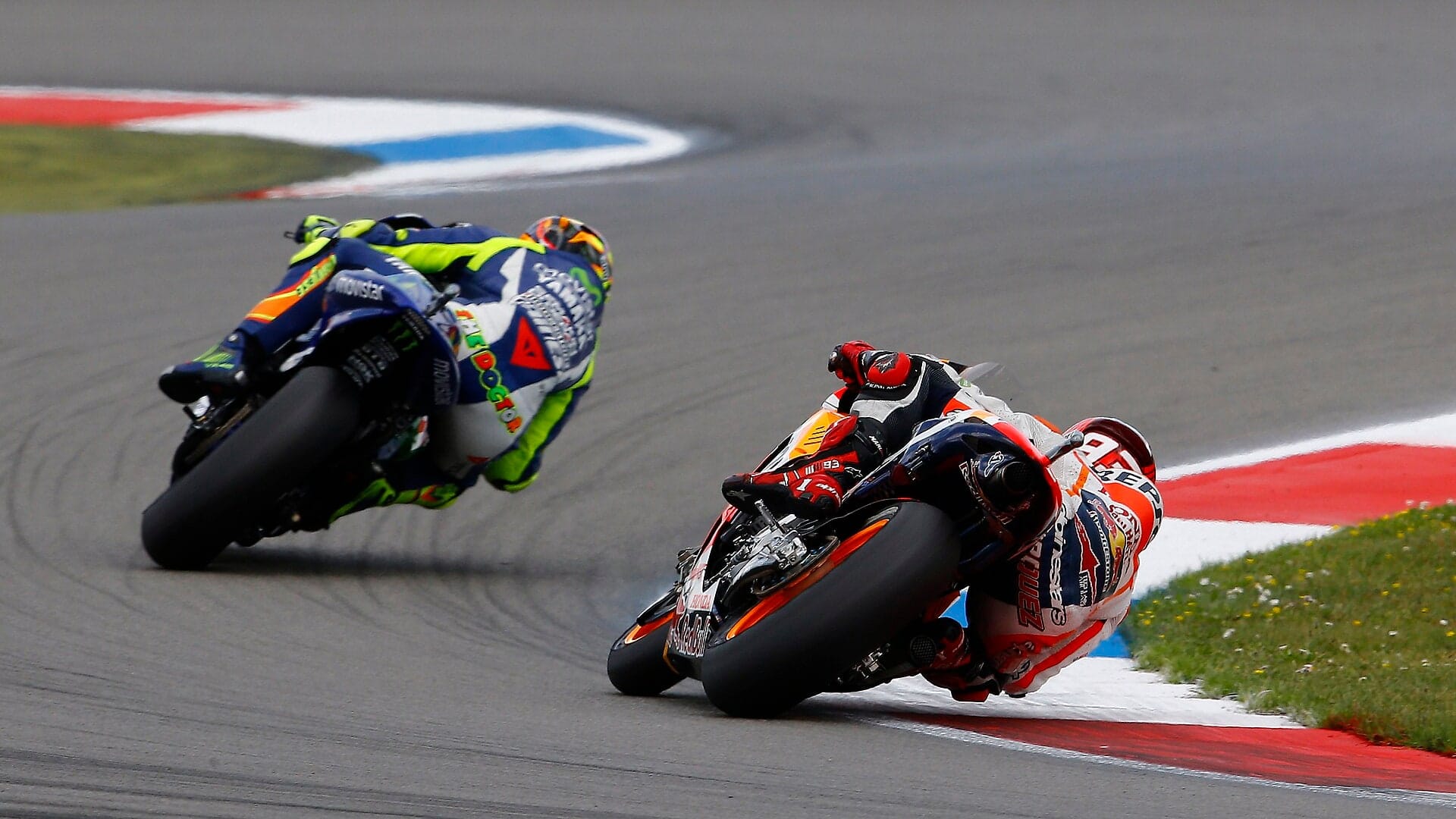
Rossi and Márquez face each other in a brutal duel for third place. The contact at turn 14 causes the Spaniard's crash and the penalty that will affect the final race.
Lorenzo finishes second, Rossi third.
The Pesaro rider's lead drops to seven points.
And in Valencia, what still fuels the debate today happens.
Valencia: when Pedrosa arrived on the two Hondas and the World Championship changed face
In the final laps of the Valencia Grand Prix, Dani Pedrosa is the rider who suddenly ignites the race.
Lorenzo leads the race. Márquez follows closely. Pedrosa, after closing the gap, reaches his team-mate.
The Honda number 26 is very fast.
Pedrosa goes on the attack against Márquez and manages to overtake him, but the response from number 93 is immediate.
Marc gives the position back to his compatriot.
The battle between the two Hondas gives Lorenzo that small margin enough to tackle the final lap still in front.
At the chequered flag the Majorcan wins with Márquez second and Pedrosa third.
And it is precisely on this moment that one of the most important questions of the entire World Championship focuses.
What would have happened if Márquez had not immediately responded to Pedrosa's attack?
There is no certain answer.
Pedrosa would first have had to catch Lorenzo and then overtake him. It is not possible to prove that he would have managed it.
But his pace in the final laps makes it legitimate to wonder whether he would have had a concrete chance.
And here a mathematical detail comes into play that shows just how fine the line was between Lorenzo's title and Rossi's.
If Pedrosa had won the race, Lorenzo had finished second and Rossi had held on to fourth place, the final standings would have been:
Valentino Rossi, 327 points.
Jorge Lorenzo, 325 points.
World champion Valentino Rossi, with a two-point lead.
Valentino would not have needed another overtake. He would not have had to recover more seconds.
It would have been enough for Lorenzo not to win that race.
Of course, this is a simulation, not proof of what would have happened.
Márquez had every right to defend his position against Pedrosa. And we do not know whether Dani would have had the time or the opportunity to overtake Lorenzo.
But the fact remains striking: the World Championship was decided also in a battle between two riders who were no longer in title contention.
A circumstance that, considering the events of the previous weeks, could only fuel questions.
First respect for the Hondas, then second thoughts
It is one of the strangest passages in the whole affair.
Immediately after Valencia, Lorenzo acknowledged that the Hondas could have put him in difficulty, going as far as to suggest that the two Spaniards had shown respect for him and for the possibility of keeping the title in Spain.
A statement that, inevitably, seemed to provide arguments for Rossi's reconstruction.
A few days later, however, Lorenzo changed his interpretation.
He explained that during the race he had not had a complete view of the situation and that, after reviewing the images, he realised that Márquez and Pedrosa had been pushing to the limit.
The problem is not that a rider cannot reconsider an episode. It is perfectly legitimate.
The problem is that, in a World Championship decided by five points and marked by huge suspicions, moving from a statement that evokes respect for the Hondas to a defence of their conduct could only fuel the controversy further.
An example of how Lorenzo's words have, at times, been rather careless in relation to the context.
The paradox: according to Lorenzo, it was Rossi who was being helped
As if that were not enough, in the following days another stance emerged.
Lorenzo claimed that some Italian riders had helped Valentino during his comeback in Valencia.
A claim that completely overturned the debate.
On one side Rossi denounced a supposed favour from Márquez to Lorenzo. On the other Lorenzo accused some countrymen of the Pesaro rider of having made his recovery easier.
Valentino's comeback, from the tail end of the field to fourth place, was certainly also helped by the difference in pace compared with many riders ahead of him.
But equating possible assisted overtakes with a supposed deliberate intervention in the battle for the win means putting different sporting situations on the same level, without proving that they were part of agreements.
And it is precisely this trait that made Lorenzo such a divisive figure: the ability to answer one controversy with another, often rather than putting it out.
"Rossi is not fast enough": the words after the title
Winning the fifth world title could have closed every debate.
Lorenzo had won. He had shown that he was one of the strongest riders of his generation. He had brought home an extraordinary championship.
Yet, after Valencia, he returned to speaking about his rival.
According to statements reported at the time by Reuters, the Majorcan said that Rossi had not had the speed required to arrive at the final race with a bigger lead.
He added that 2015 would probably have represented his last chance to win another world championship.
A harsh judgement. And, for many fans, also unnecessary.
Lorenzo had every right to claim his speed advantage that season. The seven victories to four were a concrete argument.
But attributing Rossi's defeat simply to a question of speed meant reducing a complex season to a convenient explanation for the man who had won it.
Valentino had led the standings for almost the whole championship, building his advantage on the consistency of results.
Lorenzo had often been quicker. Rossi had long been more consistent.
These are two truths that can coexist.
"Valentino deserved a heavier punishment": a rivalry beyond the limit
Lorenzo did not limit himself to criticising Rossi's behaviour in Sepang.
In the interviews that followed, he continued to insist that the treatment given to the nine-time world champion had been too lenient.
His position was clear: in his view, another rider might have received a heavier sanction.
It is a debatable opinion, but not absurd in itself.
What made it controversial was, once again, the position of the person expressing it.
Lorenzo was not a former rider called upon to comment from a TV studio. He was the main sporting beneficiary of his team-mate's difficulties.
And when a directly involved protagonist asks for a harsher punishment for the rival, the perception of impartiality inevitably becomes problematic.
From conflict to respect: the Lorenzo of 2024
The story, however, is not made up only of barbs.
In 2024, during the Festival dello Sport, Lorenzo spoke about the rivalry with Rossi in much more conciliatory terms.
He acknowledged that both would probably have won more without the other, but also that that competition made them stronger.
He expressed great respect for Valentino and for the contribution his charisma made to the popularity of motorcycling.
Mature words, very different from those spoken in the incandescent atmosphere of 2015.
And precisely for this reason it would be wrong to describe every later statement by Lorenzo as a deliberate attack on the Doctor.
The rivalry has evolved. Mutual respect, at least publicly, has grown.
But the past continues to affect the way every new statement is interpreted.
The real problem is not choosing Márquez. It is forgetting what Rossi represents
Jorge Lorenzo may consider Marc Márquez the best rider of the modern era.
It is a legitimate technical assessment.
Márquez has shown exceptional riding ability, aggression, adaptability and an uncommon determination.
But the historical value of a rider is not measured only by counting world titles or comparing lap speed.
Valentino Rossi has crossed different eras, rule changes, generations of rivals and technical transformations. He has won with Honda and Yamaha, helped make MotoGP a global phenomenon and built a remarkable racing longevity.
That does not mean he must necessarily be considered the greatest of all time.
It means that excluding him outright from a discussion of the giants of motorcycling would require arguments far stronger than a simple personal preference.
And here we must return to the current affair: it has not been established that Lorenzo really spoke that exclusionary phrase.
Attributing it to him despite the denial would mean repeating precisely the mistake this debate should avoid.
Jorge never changes his spots?
Perhaps Lorenzo's real habit is not continuously attacking Rossi.
It is that, for so many years, he has been a protagonist in controversies where technical statements, personal interests and sporting rivalries intertwined until they became indistinguishable.
2015 remains the clearest case.
The thumbs-down, the request for a heavier sanction, the words about the Hondas' behaviour, the later second thoughts and the accusations against the Italian riders form a documented sequence that explains why many fans continue to look with suspicion at his statements.
This does not erase the champion's value.
Five world titles are not won by chance. Lorenzo was one of the most precise, fast and technically refined riders of his generation.
But being a star on track does not automatically make you impeccable in front of a microphone.
Eleven years later, the 2015 World Championship is still being discussed. Lorenzo defends his title, Rossi has not forgotten that defeat and Márquez remains at the centre of a rivalry that time has not erased.
Perhaps that is the true legacy of that season.
A championship officially ended in Valencia, but one that, in the memory of millions of fans, never really finished.
And what do you think? Was Lorenzo often too controversial towards Valentino Rossi, or were his words blown up by a rivalry that still divides fans today?